
What an IV Drip at Home in Mumbai Actually Looks Like, Hour by Hour
A prescribed IV drip at home in Mumbai follows a set routine from cannula to removal. Here is what the visit involves, who it suits, and when a hospital day-care bed is the safer call.
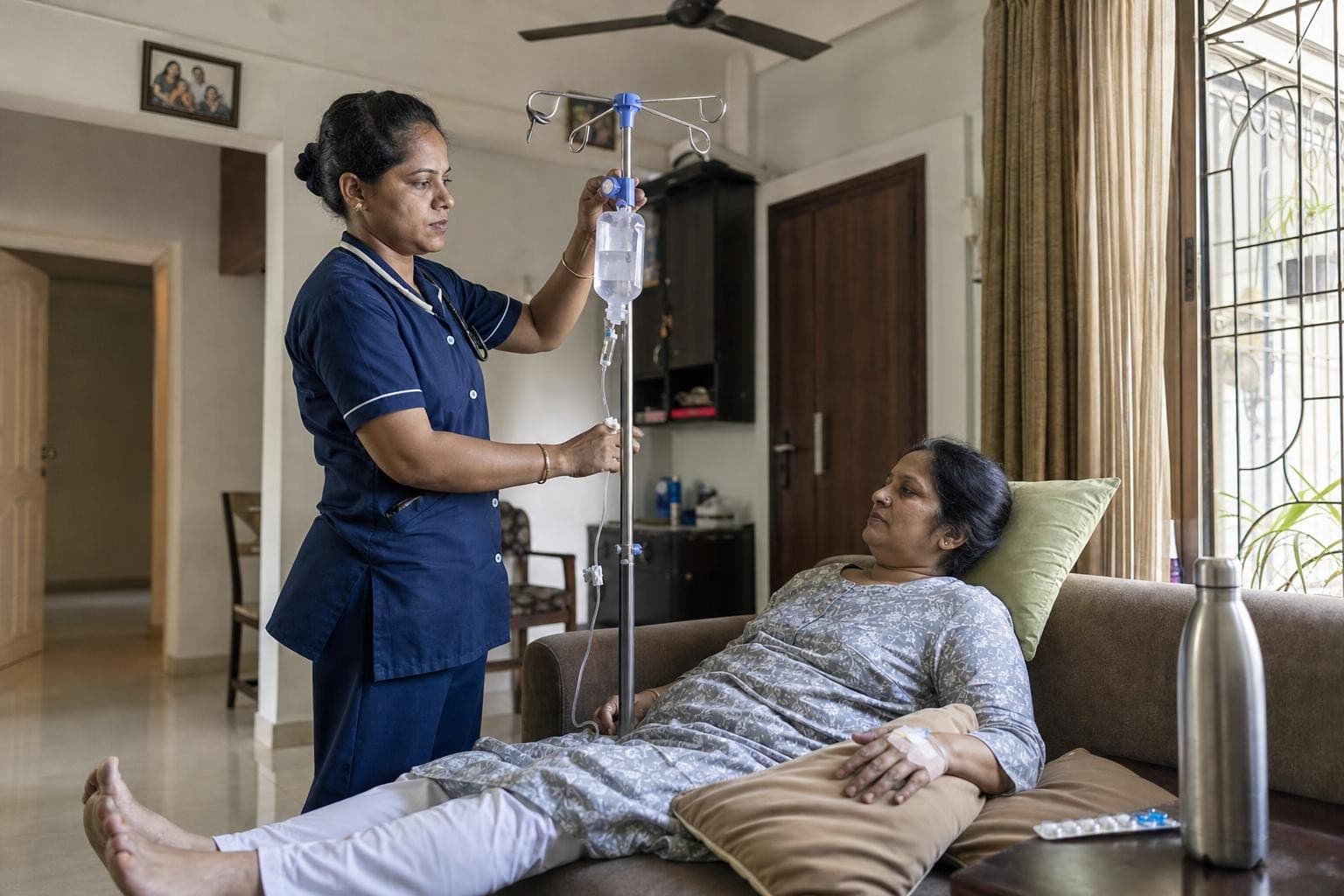
Someone at home has been vomiting since last night, or running a fever that won't break. The doctor's note says the same thing either way: fluids, IV, today.
The first question is rarely about the drip. It's whether the drip has to happen in a hospital bed, or whether it can happen on the sofa, ceiling fan on, someone's phone charger still in the plug point the nurse is about to need. An IV drip at home in Mumbai is a real alternative for a specific set of prescriptions. Knowing what the visit involves in advance is what makes the two hours pass without anxiety.
What the visit actually involves
It isn't just a needle.
It starts with the nurse checking the prescription against your ID and asking about allergies, past reactions, and whether a cannula is already in place from a recent hospital stay. If not, one goes into a vein on the back of the hand or the forearm, taped down, connected to a giving set that runs from the fluid bag on a portable stand.
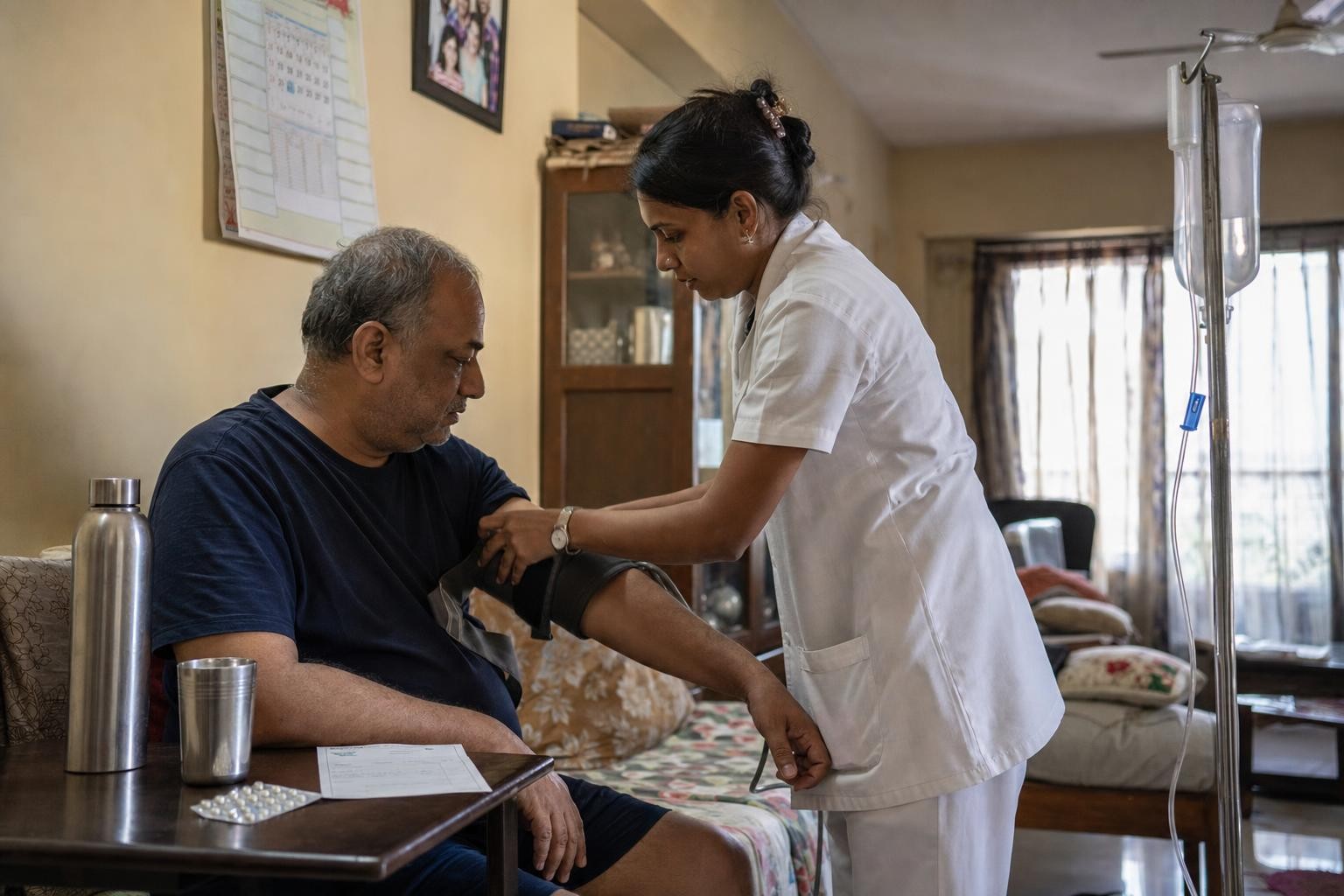
From there the drip runs at the rate the doctor specified. Sometimes by gravity, sometimes counted out in drops per minute against a watch. The nurse stays in the room for the whole infusion, not just the setup, checking the IV site for swelling and taking blood pressure and pulse through the session. That's the point of it. A dislodged cannula or a vein starting to swell gets caught while someone is watching, not found an hour later when the bag has run dry.
Sessions run two, four, or eight hours depending on what's being infused. Plain fluids for dehydration sit at the short end. A course of IV medication or a vitamin infusion stretches longer. When the bag empties, the cannula comes out, the site is dressed, and the nurse writes down what was given and how the patient tolerated it. Keep that note. The same doctor will ask about it at the follow-up.
Who is actually a candidate for one
Home infusion suits someone stable enough to sit or lie through it without monitoring beyond vitals checks. It also suits a prescription that doesn't need equipment a flat can't hold: no infusion pump running off mains power overnight, no cardiac monitor, no oxygen titration alongside the fluids.
Mild to moderate dehydration from a stomach bug. A course of prescribed IV antibiotics that doesn't need inpatient observation. Scheduled vitamin and mineral infusions. Those are the usual reasons a doctor writes "IV at home" on the prescription instead of "admit."
What the visit needs from you is simple. A clean, well-lit spot to sit or lie. A plug point nearby. Someone else in the flat for the length of the session, not because the nurse can't manage alone, but because a second pair of hands matters when something needs fetching mid-drip. The IV drip at home in Mumbai service covers cannula insertion through removal. The fluid or medication is billed separately, because that depends on the prescription, not on the visit.
When a hospital day-care bed is the safer answer
Not every IV prescription belongs at home. A good service will say so instead of booking the visit anyway.
Breathing difficulty. Chest pain. A fever that hasn't responded to medication in over a day. Signs of an allergic reaction to a previous infusion. Low blood pressure, confusion, a known cardiac history, or anything that could change quickly. All of those need a setting with a doctor and equipment on hand, not a nurse checking in from a chair every fifteen minutes.
The same goes for infants and very elderly patients on complex fluid prescriptions, where a small error in rate matters more and a hospital's monitoring catches it faster. And if the prescribing doctor has specifically asked for hospital-based IV therapy, don't work around it for convenience. A home infusion substitutes for the bed. It isn't a downgrade of it, and it only works when the case genuinely fits.
What decides the cost
Home IV pricing isn't a flat number, because the visit isn't a flat service.
Duration is the biggest factor. A two-hour hydration drip costs less than an eight-hour infusion, because the nurse's time on site scales with it. Whether a cannula needs inserting, or one is already in from a hospital discharge, changes it too. None of that includes the fluid or medication, which is billed at what the prescription calls for. Those numbers move with the prescription and with supply costs, so the IV drip at home in Mumbai page carries the live tariff instead of a figure that would go stale here.
If your prescription is injections and not an infusion, the routine and the safety checks are similar in spirit. Our guide to getting injections at home safely covers what verification and prescription checks look like for a single shot. And if you're still working out which service the discharge summary is asking for, start with the complete guide to home healthcare in Mumbai.
Questions families ask
Can any doctor's prescription be converted into a home IV visit?
Not automatically. The prescription has to specify IV fluids or medication that doesn't need hospital-only equipment or continuous monitoring. If the note is unclear, the nurse coordinating your booking will confirm before the visit, and may ask you to check back with the prescribing doctor.
Does the nurse bring the IV fluid or medicine?
Usually the family arranges it from a pharmacy beforehand, since it's specific to the prescription. The nurse carries the cannula, giving set, dressings and monitoring equipment. Not sure what to arrange? Ask when you book and it'll be confirmed against your prescription.
What if the cannula site starts hurting during the drip?
Say so immediately. The nurse checks the site through the session and will slow or stop the infusion if there's swelling, pain beyond the initial prick, or any sign the vein isn't tolerating it. This is exactly why the visit is supervised start to finish instead of left running.
Can an elderly parent with fragile veins still get a drip at home?
Often yes. An experienced nurse is used to difficult veins. But it depends on the whole picture, not the veins alone, so flag a cardiac history or other complications when you book. That's how the right professional gets sent.
How soon can a home IV visit be arranged?
Most same-day bookings in Mumbai can be confirmed within the hour, though timing depends on your area and the nurse's schedule. Evening and late-night dehydration cases are common and are generally accommodated.
Is it safe to sleep through the rest of the drip if it is running slowly?
No. The nurse stays for the entire infusion precisely because vitals and the IV site need active monitoring, not periodic checking. A supervised home IV visit is not the same as being left alone with a bag running, and no reputable service should offer it that way.
Healkin facilitates care at home and does not diagnose, prescribe, or change a doctor's treatment plan. If you notice fever, breathlessness, swelling at the IV site, or any symptom that concerns you, call your own doctor rather than waiting for the next scheduled visit.