
Oxygen Concentrator vs Cylinder at Home: Which One Actually Matches the Prescription
A pulmonologist's oxygen prescription usually decides this for you, not the other way round. Here is how flow rate, duration and your electricity connection point to a concentrator or a cylinder, and what nobody should adjust without a doctor.
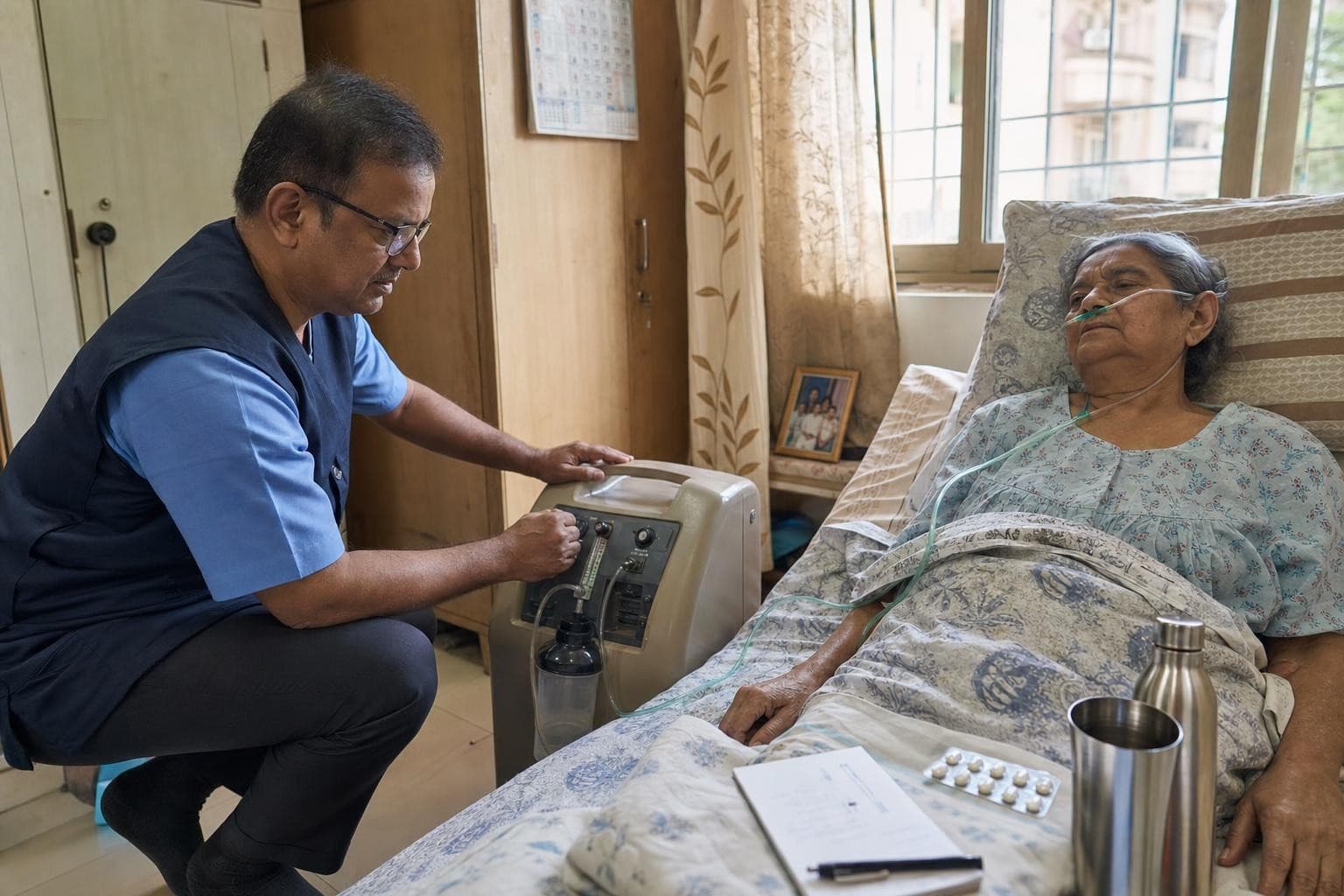
The prescription says "2 litres per minute, continuous." It doesn't say whether that means a machine that hums in the corner of the room or a cylinder that gets swapped out every few days. Families end up deciding that part themselves, usually at a chemist's counter, usually in a hurry.
It shouldn't be a guess. A concentrator and a cylinder do the same job in different ways, and the prescription itself already points toward one of them. Once you know what to read off it, the choice is quick.
What each machine is actually doing
A cylinder holds a fixed amount of pure, compressed oxygen. Once it's empty, it's empty. Someone has to arrange a refill or a swap, and the supply runs out exactly when the gauge says it will, not a minute later.
A concentrator does something different. It pulls in ordinary room air, strips out the nitrogen, and pushes out oxygen at a concentration a cylinder is filled with from the start. As long as the power stays on, it doesn't run out. That's the whole trade-off in one sentence: a cylinder is a stored quantity, a concentrator is a running supply tied to electricity.
Neither is "better" in the abstract. They're built for different situations, and the prescription is what tells you which situation you're in.
Reading the prescription correctly
Two numbers on that slip matter more than anything else: the flow rate in litres per minute, and whether it says continuous or intermittent.
Up to about 5 LPM, continuous, is the range a standard 5-litre concentrator covers comfortably. Above that, or when a doctor has written 10 LPM for someone in more acute respiratory distress, a 10-litre continuous concentrator is usually what's needed rather than stacking two smaller machines. The medical equipment rental page lists both capacities, along with the wheelchairs and beds that usually get rented alongside long recovery.
A prescription for intermittent, low-flow use, say for a short walk or a meal, sometimes suits a portable cylinder better than a machine tethered to an extension cord. That's the other half of the decision: not just how much oxygen, but how much the person needs to move around while getting it.
Either way, this isn't a number to round up or down on your own. A flow rate exists because a pulmonologist read someone's oxygen saturation and decided what corrects it. Guessing at 3 LPM because that's what the neighbour's father used is not a substitute for that reading.
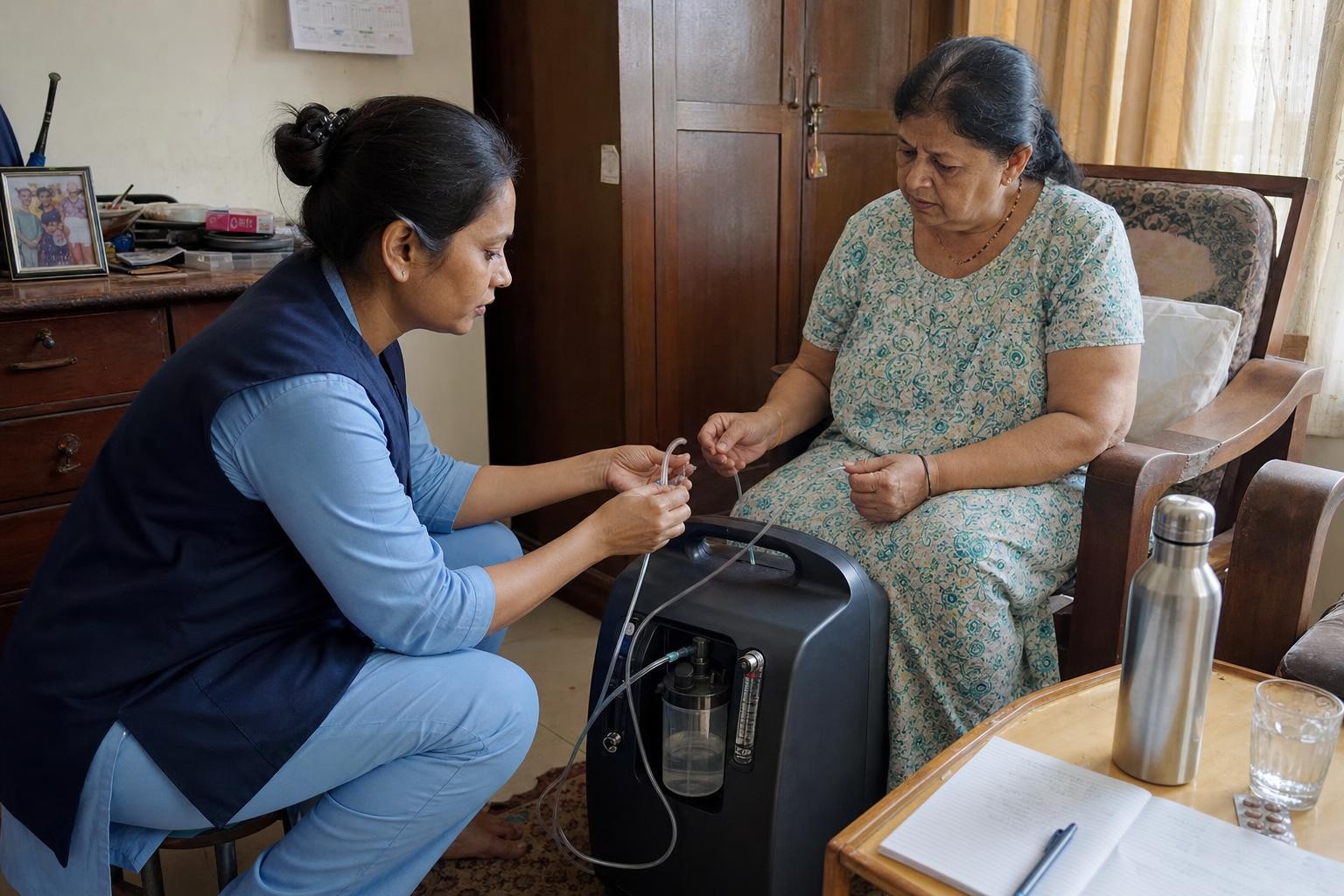
What a Mumbai flat adds to the decision
Two practical things change this calculation once the machine is actually in your home: the electricity bill, and what happens when the power cuts out.
A concentrator draws power continuously for as long as it runs, which for round-the-clock use adds a real amount to a monthly bill. It's a predictable cost once you've run it for a week, not a mystery. Ask your rental provider for a rough estimate before the machine arrives, not after.
The bigger question is what happens during a power cut. Mumbai's supply is mostly reliable, but "mostly" isn't "always," and a concentrator without backup goes silent the moment the power does. A cylinder doesn't care about the grid at all. Many families keep a small backup cylinder in the flat even when a concentrator is the everyday machine, purely for that gap between the lights going out and the inverter or generator picking up. If the flow rate is high or the patient's condition doesn't tolerate even a short interruption, that backup isn't optional.
A concentrator that isn't running because the power is out is not a backup plan. It's the reason you need one.
Delivery and installation is part of the rental either way. A technician sets the machine up, shows the family the flow meter and the humidifier bottle, and walks through the tubing before leaving. That first demonstration is worth paying attention to, because adjusting the dial yourself later is exactly what you shouldn't do without the same doctor's say-so.
What families should never adjust themselves
The flow rate on the machine is not a comfort setting. Turning it up because someone seems breathless, or down because the tubing feels awkward, changes the amount of oxygen reaching the blood in ways that aren't obvious just by watching someone's face.
If breathing seems worse, or better, than it did when the doctor last checked, that's a reason to call the doctor and describe it, not a reason to reach for the dial. The same goes for switching between a cylinder and a concentrator mid-course. If a doctor prescribed continuous flow at a specific rate, both machines need to deliver that same rate, not whatever each one happens to be set to out of the box.
Equipment troubleshooting is different from prescription changes. A concentrator that starts beeping, a cylinder gauge that reads oddly, or tubing that's come loose are things to call your rental provider about immediately. A patient who seems more breathless than before, confused, or has bluish lips or fingertips is a call to a doctor or an ambulance, not a call about the machine.
Questions families ask
How do I know if I need a 5-litre or 10-litre concentrator?
Your prescription's flow rate decides this. Up to roughly 5 litres per minute of continuous flow, a 5-litre machine covers it. Higher flow rates or more acute respiratory distress usually call for a 10-litre continuous concentrator, as your pulmonologist specifies.
Is a concentrator noisy enough to disturb sleep?
Most modern concentrators run at a steady hum, closer to a quiet fan than anything disruptive, though it's audible in a silent room at night. Placing it a little further from the bed, with the tubing length to match, usually solves this without affecting the flow.
Can I rent just a cylinder for occasional use instead of a concentrator?
Yes, for prescriptions that call for intermittent or lower-flow oxygen rather than round-the-clock continuous use. Ask what your specific prescription needs when you arrange the rental, since the answer depends on flow rate and duration, not personal preference.
Do I need a prescription to rent oxygen equipment?
Yes. Oxygen concentrators and cylinders are rented against a valid prescription, because the flow rate and duration are a doctor's decision, not a rental preference.
What happens if the concentrator stops working suddenly?
Call your rental provider immediately for a replacement or repair, and switch to a backup cylinder if one is available at home. If the patient shows breathlessness, bluish lips, or confusion in the meantime, that is an emergency and needs a doctor or ambulance, not a wait for the technician.
How often does an oxygen concentrator need servicing?
Filters need periodic cleaning and the machine benefits from a professional check every few months of continuous use. A rental provider should tell you this schedule at delivery. Don't wait for a drop in performance to ask.
Healkin facilitates care at home and does not diagnose, prescribe or change a doctor's treatment plan. If oxygen levels, breathing, or the equipment itself seem off in any way, call your own doctor or your rental provider rather than waiting for the next scheduled check.