Bedsore Treatment at Home: The Turning Routine That Stops One Before It Starts
A pressure sore can start on a bedbound patient within hours, not days. Here is the two-hourly turning routine that prevents one, and the point at which a red patch has become a wound that needs a nurse.
In the first days after someone becomes bedbound, from a stroke, a fracture, or just being too weak to get up, the family's attention goes to the big things. Medication timing. Physiotherapy. Whether the patient ate anything.
A small red patch on the tailbone looks like the least urgent thing in the room. It isn't.
Bedsore treatment at home starts with one fact: a pressure sore is not a slow injury that gives you weeks of warning. In someone frail, thin-skinned or poorly nourished, damage under unrelieved pressure can begin within two hours. Long before anyone thinks to look.
Why pressure sores start faster than families expect
Skin over a bone survives on blood flow that a body's own weight can shut off completely. The tailbone, the hips, the heels, the shoulder blades, the back of the head. Lie in one position too long and the supply stops.
The surface can look perfectly fine while the tissue underneath is already starved of oxygen. That's why a sore that seems to appear overnight was usually building for a day or two first.
Two things speed it up, and both are common at home. Friction and shear: the sliding that happens when a patient is dragged up the bed instead of lifted, or slumps against the headboard. It tears the deeper layers even when nothing on the surface is scraped. Moisture: sweat, urine, or a dressing left too long softens skin until it breaks down under far less pressure than dry skin would take. A patient who is bedbound and also incontinent or feverish carries both risks at once. That's why hygiene care and turning are really the same job, not two.
Clinically, pressure sores come in stages. Stage one is unbroken skin that stays red after pressure is removed. Stage two has broken the surface, a shallow open wound or a blister. Three and four go deeper, into fat and eventually muscle or bone. Your job isn't to diagnose the stage. It's to catch stage one before it becomes stage two, because that's the only stage turning alone can fully reverse.
The two-hourly turning routine families can run themselves
The routine is easy to describe and hard to keep up at 3am. That's why it collapses in most households inside a week unless somebody commits it to paper.
The core rule: no bony area carries the patient's full weight for more than two hours, day or night.
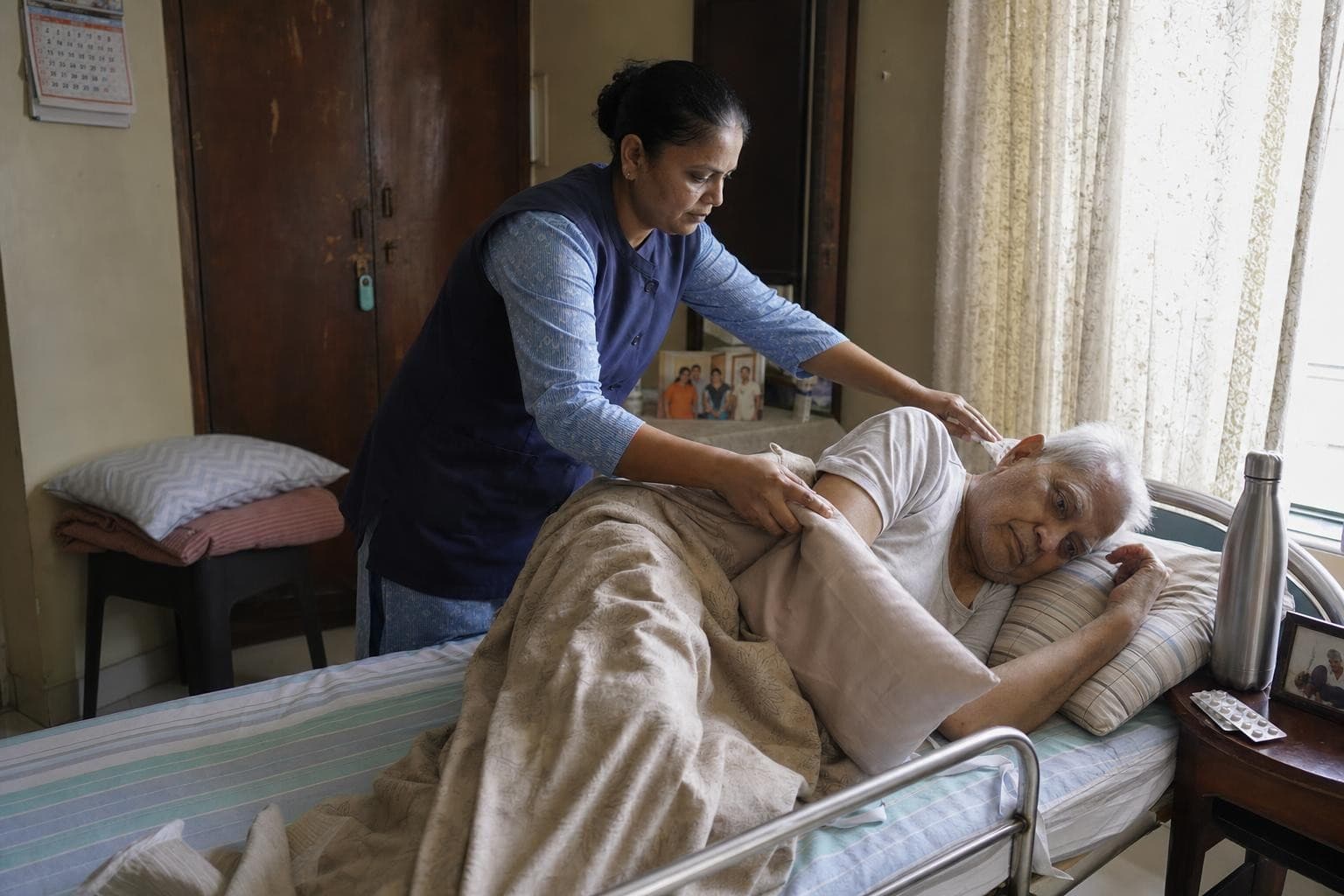
A basic rotation moves them through left side, back, right side, never twice in a row on the same spot. On a side, a pillow behind the back stops them rolling flat again. Aim for about a thirty-degree tilt rather than straight down on the hip bone, because a full ninety-degree turn puts all the weight on one small area and defeats the point. Heels need their own answer. They take enormous pressure from the weight of the legs alone, and the fix isn't a soft pad. Put a pillow lengthwise under the calves so the heel floats free of the mattress entirely.
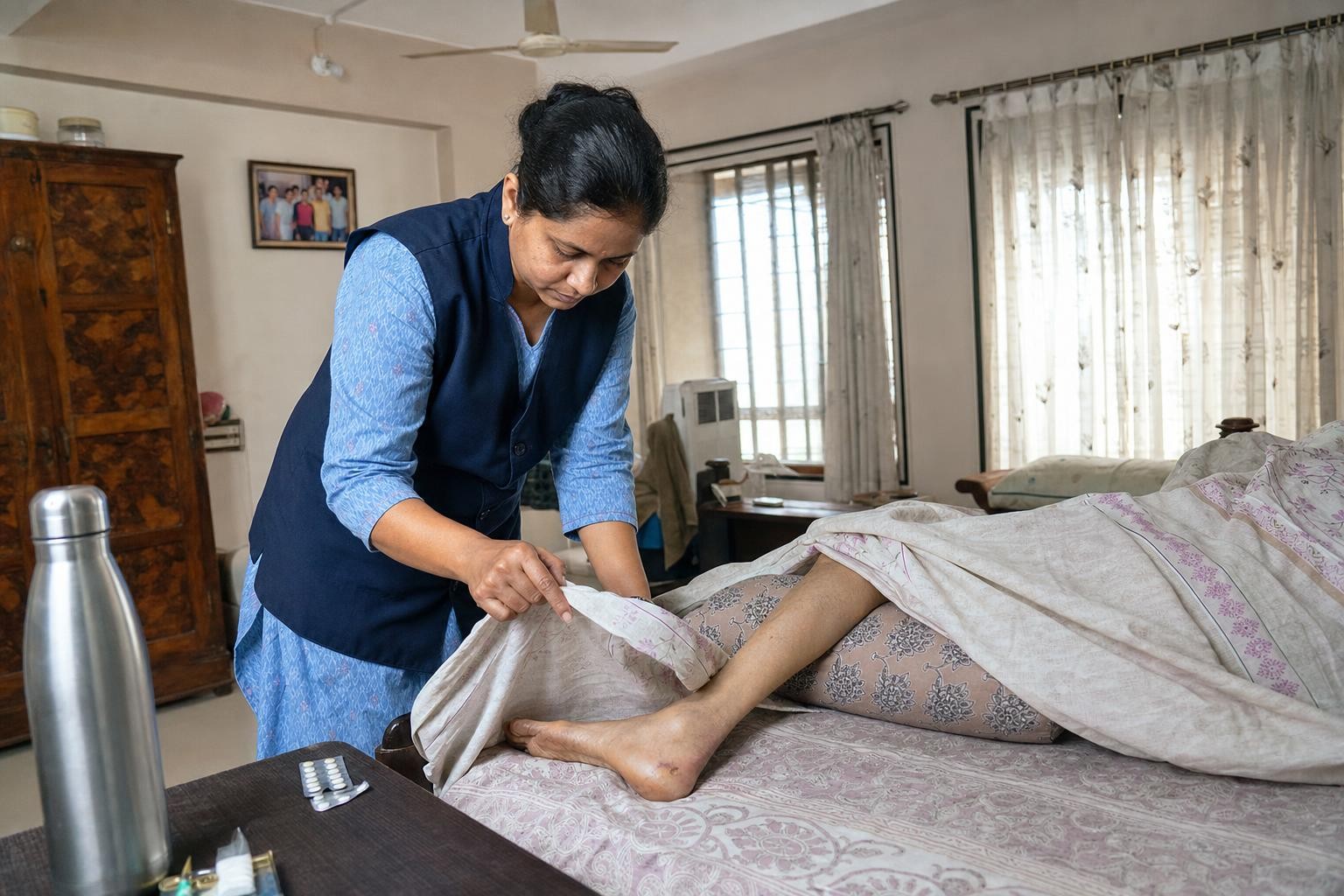
Every turn is also a skin check. Look at the tailbone, both hips, both heels and the elbows, and press a fingertip briefly on any red patch. Skin that whitens under the press and flushes back afterwards is normal. Skin that stays red, or looks purplish, and never whitens at all is the earliest sign of damage. Tighten the schedule then. Not in a day or two.
A red mark that does not turn pale under a fingertip is not "irritation to watch." It is a pressure sore that has already started.
Write the rotation down. A sheet of paper on the bedside table with the time and position of each turn, kept by whoever is on shift, is the difference between a routine that happens every two hours and one that quietly slides to every four once everyone is exhausted. Night turns count as much as day ones. A sore doesn't pause because the house is asleep.
The stage at which it stops being a home job
A turning routine kept honestly prevents most pressure sores from ever breaking the skin. Once one has, the calculation changes. Knowing where that line sits matters more than any single technique.
Unbroken red skin that fades within thirty minutes of a turn, no blister, no open area, is still a home job with a stricter rotation and closer checks.
The moment skin actually breaks, even a small blister or a shallow raw patch, the wound needs someone trained in wound care. A dressing chosen wrongly for a pressure sore traps moisture and makes it worse. So does waiting. A sore getting larger or deeper despite a properly kept schedule, one with yellow or black tissue at its base, one that smells, or one ringed by spreading redness or warmth, is past what any family should manage alone. However carefully they've followed the routine.
Fever in a patient with a known pressure sore is not a coincidence to wait out. It's often the first outside sign that the wound has become infected under the dressing, and it needs same-day attention. Same if an alert patient suddenly seems drowsy or confused, because that's how infection often shows itself in someone elderly.
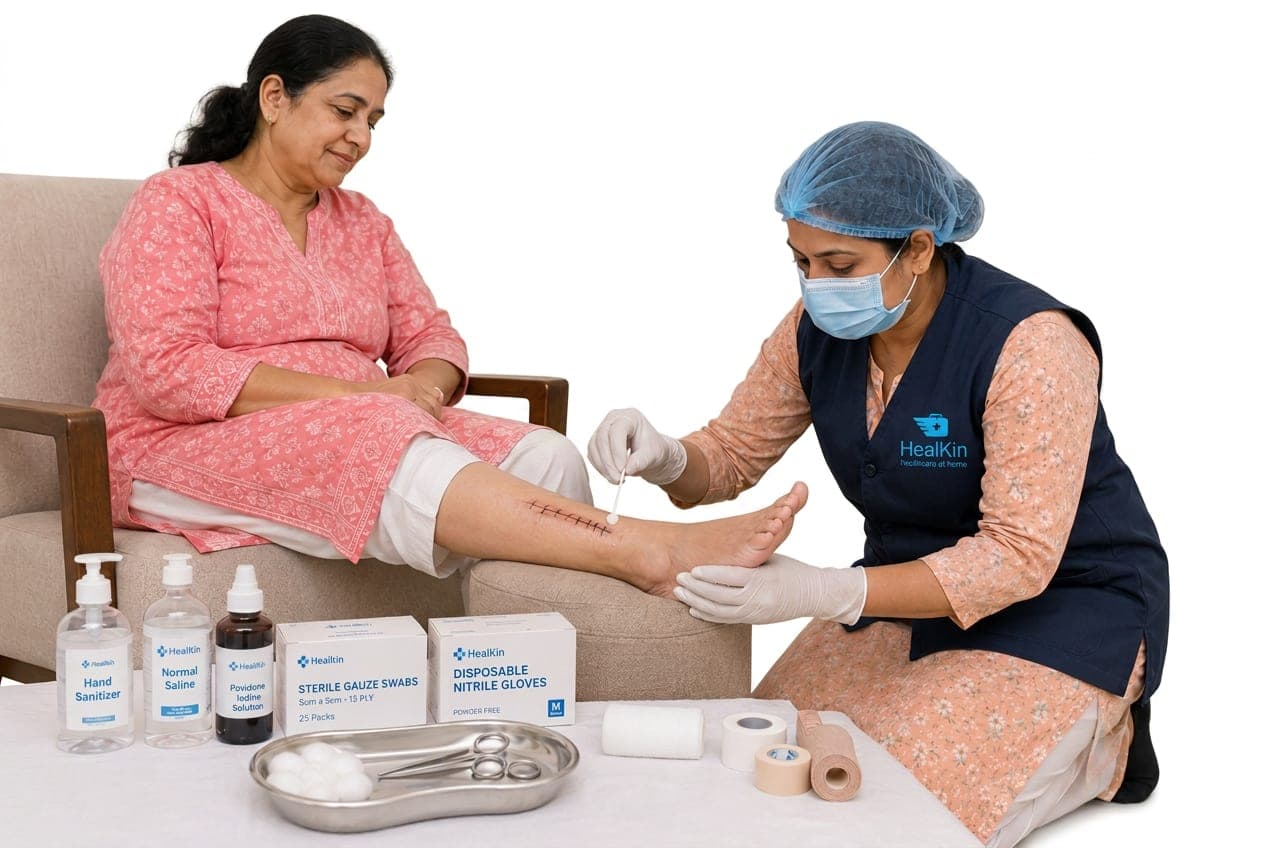
This is usually the point where the mattress becomes part of the answer too. A pressure-relieving air mattress shifts contact points on its own and takes some of the load off the two-hourly schedule, which helps most overnight, or with a patient too frail to be turned as often as the sore now needs. Home visits for bedsore and pressure wound dressing, alongside standard wound care and suture removal, are on the wound dressing at home in Mumbai page, with the current tariff, since the visit depends on the stage and size of the wound.
If your patient is recovering from recent surgery rather than in long-term bedbound care, our piece on wound dressing at home after surgery covers the fortnight after discharge in the same practical detail.
Questions families ask
Is a small red patch already a bedsore, or just normal skin irritation?
Turn the patient off the spot and wait half an hour. If it fades to normal skin tone, it's early warning, not yet a sore, and a stricter turning schedule usually reverses it. If it stays red or looks purplish, treat it as a stage one pressure sore and tighten the routine now.
Can turning alone heal a sore that has already broken the skin?
No. Turning prevents new damage and stops an existing sore worsening. Once skin has broken, the wound needs proper cleaning and dressing from someone trained in wound care, on a schedule suited to that specific wound. General skincare won't do it.
How often should the skin actually be checked, separately from turning?
At every turn. Not on a separate schedule. It takes under a minute, and it's the only way to catch a red patch on day one instead of day three, by which point it may already be breaking down.
Does every bedbound patient need a pressure-relieving mattress?
Not from day one. But the longer someone is expected to stay bedbound, and the frailer or thinner they are, the sooner it stops being optional. It earns its cost fastest in a household that can't realistically manage a true two-hourly schedule overnight.
What is the single biggest mistake families make with bedsore prevention?
Relying on memory instead of a written schedule. A rotation everyone agrees to in the morning slips once the household is tired, and that is exactly when most sores start.
Can a nurse take over the turning routine entirely, or only the dressing?
Both are available. Some families book visits only for wound assessment and dressing and manage the turning themselves. Others arrange a nurse or attendant for extended hours precisely because a two-hourly schedule is hard to sustain alone, especially at night.
Healkin facilitates care at home and does not diagnose, prescribe, or change a doctor's treatment plan. If skin stays red without fading, breaks open, or you notice fever, spreading redness, or a foul smell from a wound, call your doctor rather than waiting for the next scheduled visit.