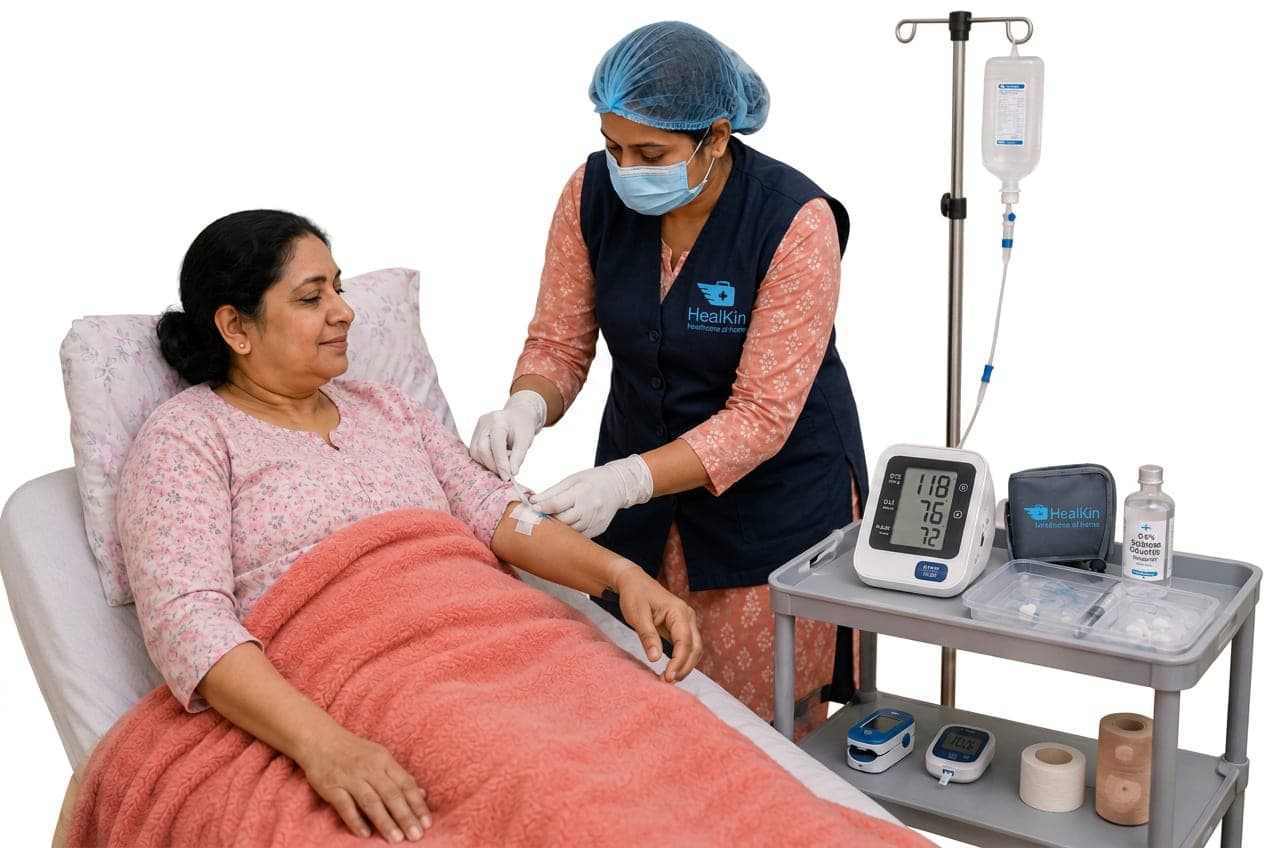
IV Drip Infusion: What Actually Happens During the Treatment and When Is It Needed?
Learn what happens during an IV drip infusion, why it may be prescribed, how long it takes, safety considerations and when IV treatment can be given at home.

For many people, the words “IV drip” immediately bring to mind a hospital bed, a hanging fluid bag and a needle in the arm. While IV treatment is common, patients and families often have questions about what actually happens during an infusion, why it has been prescribed, how long it takes and whether it can be administered at home.
An IV drip infusion, or intravenous infusion, delivers fluids or prescribed medication directly into a vein. Depending on the treatment, it may be used to provide fluids, electrolytes or medicines when intravenous administration is clinically appropriate.
For suitable patients, some forms of IV treatment can also be provided outside a hospital, including through supervised home IV services. However, home administration is appropriate only when the patient's condition and prescribed treatment allow it.
What Is an IV Drip Infusion?
IV stands for intravenous, meaning “into a vein.”
During an IV infusion, a healthcare professional places a small, flexible tube called a cannula into a suitable vein, usually in the hand or arm. The cannula is then connected to an IV line through which the prescribed fluid or medication is delivered gradually.
The contents of the infusion depend entirely on the patient's treatment plan.
For one patient, it may be IV fluids. For another, it may be a prescribed medication. Some patients may receive IV therapy as part of treatment that continues after discharge from hospital.
This is why an IV drip should not be viewed as a general treatment for tiredness, weakness or dehydration without first understanding the underlying reason and medical advice.
Why Might Someone Need an IV Infusion?
There are several medical situations in which intravenous treatment may be considered.
IV fluids can be used to replace fluid and electrolytes when a patient has significant fluid losses or cannot adequately maintain hydration through drinking.
IV medication may also be prescribed when a medicine needs to be delivered directly into the bloodstream. For certain treatments, intravenous administration may be part of a planned course of care.
The important point is that the reason for the infusion matters.
An IV should be given because there is a clinical reason for it, not simply because it appears to work faster than taking fluids or medication by mouth.
What Happens Before the IV Drip Begins?
The infusion itself is only one part of the process.
Before starting, the healthcare professional should review the prescription and confirm the patient's identity and treatment requirements. Relevant medical information, including allergies or previous reactions to medication or IV treatment, should also be discussed.
If you are unsure what is being administered, ask.
A patient should know:
What medication or fluid is being given?
Why has it been prescribed?
Approximately how long will the infusion take?
Are there any specific precautions?
What should you report if you feel unwell?
These are straightforward questions and can make patients much more comfortable with the treatment.
Does an IV Cannula Hurt?
There is usually a brief sting or pinch when the cannula is inserted.
A needle is used to access the vein, after which the needle is removed and the flexible cannula remains in position.
The initial discomfort is generally short-lived, but experiences vary from person to person.
Once the cannula is secured, the patient should tell the healthcare professional if there is significant pain, swelling, burning or increasing discomfort around the insertion site.
It is better to mention a problem early than to assume that discomfort is something you simply have to tolerate.
What Happens While the IV Is Running?
Once the cannula is in place, the prescribed fluid or medication is allowed to flow through the IV line at the required rate.
The length of the infusion depends on the treatment. Some infusions may be relatively short, while others can take considerably longer.
During the treatment, the healthcare professional may monitor the patient and observe the IV site for any problems.
For a routine infusion, patients may be able to sit comfortably, read, use their phone or simply rest, depending on their condition and the instructions provided by the healthcare professional.
If you develop unusual symptoms during the infusion, inform the healthcare professional immediately.
How Long Does an IV Drip Take?
There is no standard duration for every IV infusion.
The treatment time depends on factors such as:
The type of fluid or medication
The amount being administered
The prescribed infusion rate
The patient's medical condition
The type of IV access being used
For this reason, it is not useful to compare your infusion time with someone else's.
A slower infusion is not necessarily a sign that something is wrong, just as a shorter infusion does not necessarily mean it is more effective. The treatment should be administered according to the prescription and clinical requirements.
Can an IV Drip Be Given at Home?
In some circumstances, yes.
Home IV therapy is already used in various healthcare settings for selected patients who have been assessed as suitable for treatment outside the hospital. Depending on the treatment, trained healthcare professionals can administer IV medication or fluids and provide care for the IV access device.
For patients who have difficulty travelling, this can be particularly convenient.
Consider an elderly patient recovering after hospitalisation. Travelling to a clinic may involve arranging transport, navigating traffic, managing mobility difficulties and waiting for treatment.
If the prescribed treatment is appropriate for home administration, having a trained healthcare professional visit the patient's home can make the process considerably easier for the patient and family.
However, not every IV treatment is suitable for home administration.
The patient's condition, the medication being given and the level of monitoring required all need to be considered.
What Happens During an IV Drip at Home?
A home IV visit should still be treated as a medical procedure.
The healthcare professional typically begins by confirming the patient's details and prescription and reviewing relevant information before starting treatment.
If a new peripheral cannula is required, it is inserted using appropriate infection-control precautions. The prescribed infusion is then connected and administered according to the treatment instructions.
The patient can remain comfortably seated or lying down while the infusion is running.
The healthcare professional monitors the IV site and the patient's condition during the treatment and responds if there are concerns.
Home IV services are intended for appropriate, stable cases—not medical emergencies.
Why Infection Control Matters During IV Treatment
One of the most important aspects of IV treatment is maintaining proper infection-control practices.
Because an IV provides access to the bloodstream, sterile equipment and appropriate aseptic technique are essential.
The CDC recommends aseptic technique when preparing and administering IV medications and states that needles, syringes and IV administration sets should not be reused between patients.
For patients receiving IV treatment at home, it is reasonable to ask about the healthcare professional's qualifications and the safety procedures followed during the visit.
Professional home healthcare should not mean compromising on clinical standards.
When Is Hospital Treatment More Appropriate?
Home treatment is not suitable for every situation.
If a patient has severe breathing difficulty, chest pain, loss of consciousness, severe confusion, a serious allergic reaction or rapidly worsening symptoms, emergency medical assessment should take priority over arranging a routine home IV visit.
A hospital or emergency department can provide immediate assessment, monitoring and treatment when a patient's condition requires a higher level of care.
Similarly, if a doctor has specifically instructed that an infusion be administered in a hospital or monitored clinical setting, that recommendation should be followed.
What Should You Do After an IV Infusion?
Once the prescribed infusion is complete, the healthcare professional will determine the appropriate next step.
For a short-term peripheral IV, the cannula is usually removed and the area covered with a small dressing.
Patients should pay attention to the IV site afterward. Increasing redness, swelling, bleeding or significant pain should be reported to an appropriate healthcare professional.
If you have been given specific post-treatment instructions, follow those instructions rather than relying on general advice.
Is an IV Drip Better Than Drinking Fluids?
Not automatically.
This is an important distinction, particularly because IV treatments are sometimes marketed as a quick solution for tiredness or dehydration.
If a person can safely drink enough fluids and does not have a medical reason requiring intravenous treatment, an IV may not be necessary.
IV therapy has specific medical uses. The decision to administer fluids or medication intravenously should be based on the patient's condition and treatment plan.
In other words, an IV drip is a medical treatment, not simply a faster version of drinking water.
Questions to Ask Before Arranging IV Drip Infusion at Home
If you have been prescribed IV treatment and are considering a home visit, ask the healthcare provider or service:
What exactly has been prescribed?
Is this treatment suitable for administration at home?
Who will administer the infusion?
How long is the infusion expected to take?
What is included in the service cost?
What should I do if I experience a reaction during the infusion?
Who should I contact if I have concerns after the treatment?
Having these details beforehand can make the appointment much more straightforward.
IV Drip Infusion at Home in Mumbai
For patients who have a valid prescription and are suitable for home treatment, IV drip infusion at home in Mumbai can offer a practical alternative to travelling to a clinic.
Healkin provides home healthcare services in Mumbai, including selected IV drip services administered by healthcare professionals. The suitability of home treatment depends on the patient's condition and prescribed therapy.
For families caring for elderly patients, people recovering after hospitalisation or patients who have difficulty travelling, home healthcare can reduce the practical challenges involved in accessing routine treatment.
The priority, however, should always remain the same: appropriate treatment, qualified healthcare professionals and patient safety.
Final Thoughts
An IV drip may look complicated when you first see it, but the basic process is straightforward. A small cannula provides access to a vein, and prescribed fluid or medication is delivered gradually while the patient is monitored appropriately.
What matters most is not simply having an IV drip, but understanding why it has been prescribed, whether it is appropriate for you, and who is administering it.
For suitable patients, home IV infusion can make treatment more convenient without requiring an unnecessary trip to a healthcare facility. But convenience should never replace proper medical assessment.
If you have been prescribed IV treatment and are considering IV drip infusion at home in Mumbai, speak with a qualified healthcare professional about whether home administration is appropriate for your particular treatment.
Frequently Asked Questions
What is an IV drip infusion?
An IV drip infusion delivers prescribed fluids or medication directly into a vein through a cannula.
How long does an IV drip take?
The duration varies according to the medication or fluid, prescribed rate and individual treatment plan.
Is IV drip infusion painful?
The insertion of the cannula may cause a brief pinch or sting. Significant or increasing pain during the infusion should be reported.
Can IV infusion be done at home?
Some prescribed IV treatments can be administered at home when the patient is clinically suitable and the treatment does not require hospital-level monitoring.
Is an IV drip suitable for everyone?
No. The need for IV treatment and whether it can safely be given at home depends on the patient's medical condition and prescribed treatment.
Can I eat or use my phone during an IV infusion?
For many routine infusions, patients can sit comfortably and use their phone or read, provided their healthcare professional has not given different instructions.
What should I do if I feel unwell during an IV infusion?
Tell the healthcare professional immediately. If severe or emergency symptoms occur, seek urgent medical attention.
Medical Disclaimer:
This article is intended for general educational purposes and does not replace medical advice, diagnosis or treatment from a qualified healthcare professional. IV fluids and medications should be administered only when appropriately prescribed and by trained healthcare professionals.