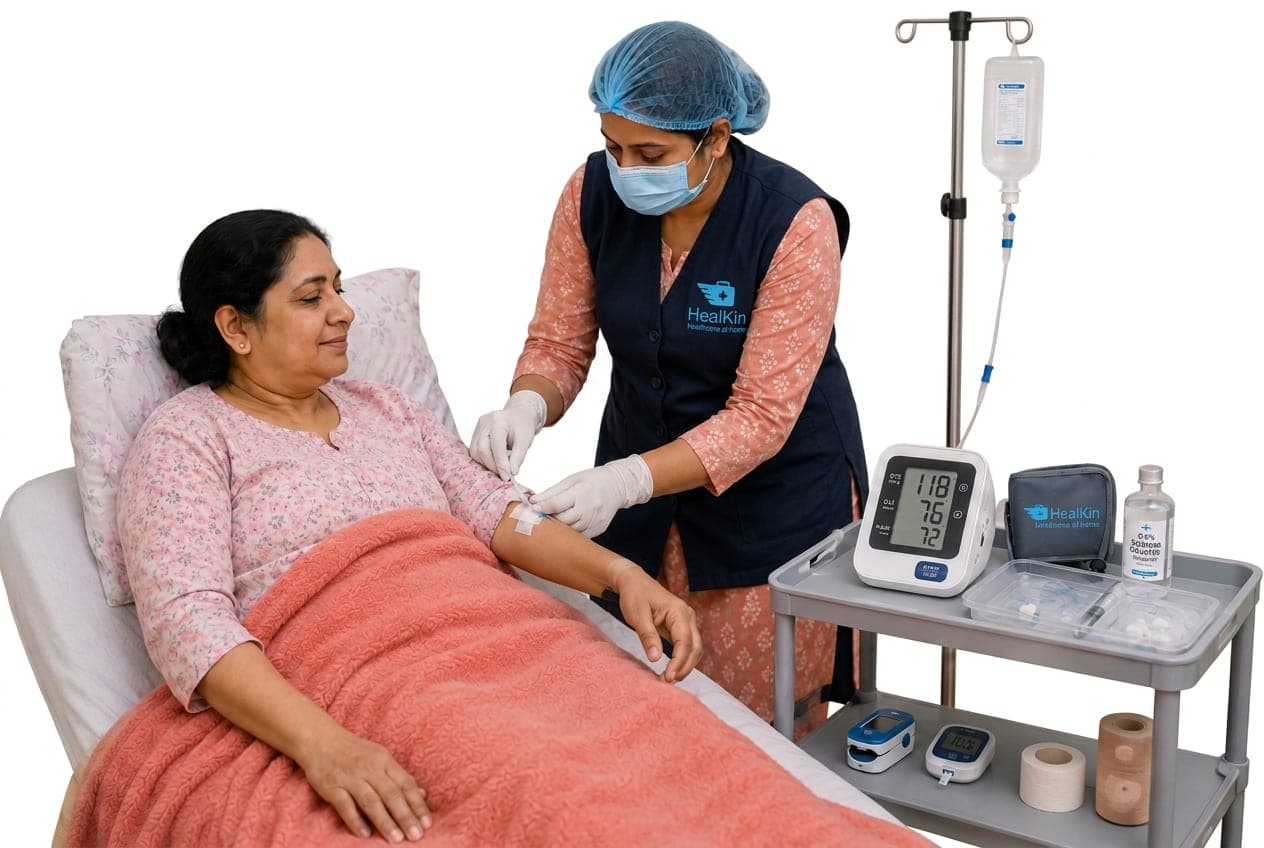
IV Drip Near Me: What You Should Know Before Booking an IV at Home in Mumbai
Looking for an IV drip near you in Mumbai? Learn when IV treatment can be given at home, what the visit involves, costs, safety and when hospital care is better.
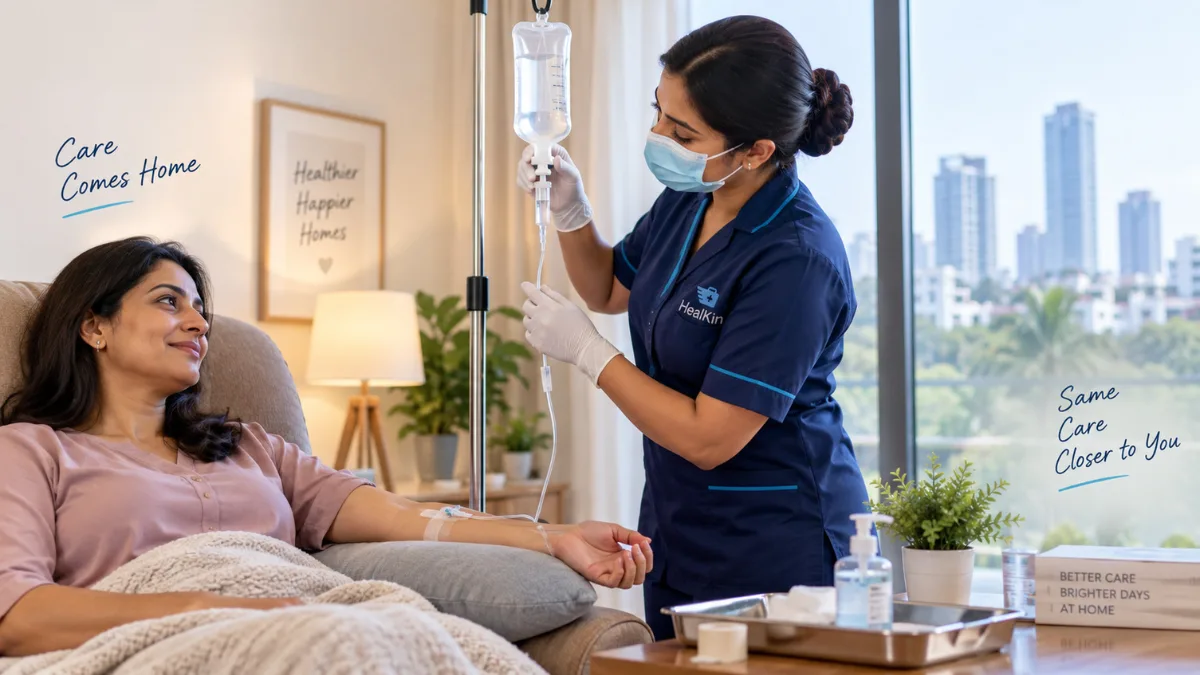
When you search for “IV drip near me,” you’re probably not interested in a detailed explanation of intravenous therapy.
But the question you probably want to ask is a little more immediate.
Where can I get the treatment and is there someone who can come to my home?
This is particularly so in the case of Mumbai. Getting an elderly parent or someone recovering from an illness or a patient just back from the hospital into a car and through traffic isn't always easy. A medical appointment, even a brief one, may require hours of travel and waiting.
That’s where home health care comes into play.
In some situations, a doctor-prescribed IV treatment can be administered at home by a trained healthcare professional. But an IV drip is not something you get because it’s convenient. The first thing to consider is the condition of the patient, the fluid or med that is ordered, and the level of monitoring required.
So, if you are looking for an IV drip near me in Mumbai, here’s what you need to know before booking one.
What do people usually search for when they type in “IV drip near me”?
The expression means different things in different contexts.
Someone is looking for an IV clinic near me. Someone else might need a nurse to come to the house to give an IV medication that has been prescribed. A family member may be looking for someone after being discharged from hospital because the patient has been told to continue treatment outside the hospital.
In many cases, the real search is:
“Can I get this IV treatment without taking the patient to a clinic?”
If that's what you need, an IV drip at home in Mumbai may be an option when the patient is medically suitable for home-based care.
The important part is the word suitable.
Home treatment isn't right for every patient or every IV medication.
Is an IV Drip at Home Safe?
It can be, when the treatment is appropriate for home administration and is carried out by a qualified healthcare professional using proper procedures.
An IV line is a direct access to the bloodstream and that is why it should not be treated as a home remedy. The prescribed treatment needs to be checked. The patient needs to be appropriately assessed. Infection control precautions need to be adhered to.
The healthcare professional should also know what to do if the patient develops an unexpected reaction during the infusion.
This is one reason it is worth looking beyond the first result that appears when you search “IV drip near me.”
Ask yourself:
Is the treatment prescribed or medically advised?
Who will administer it?
Is the patient stable enough for home treatment?
What exactly is included in the service?
What happens if the patient develops a problem during the infusion?
A low price or quick appointment isn't much help if these basic questions aren't answered.
Who Can Get an IV Drip at Home?
There isn't one type of patient who automatically qualifies for home IV treatment.
A doctor may recommend home administration for a patient whose condition is stable and whose prescribed treatment doesn't require hospital-level monitoring.
Depending on the individual case, home IV treatment may be considered for things such as prescribed IV fluids, certain medications, scheduled infusions, or treatment that needs to continue after a hospital stay.
The exact treatment and suitability will always depend on the patient's medical condition and prescription.
For example, someone who has difficulty travelling but is otherwise stable may be a reasonable candidate for home treatment. Someone who is becoming seriously unwell may need a hospital instead.
That distinction matters.
When Is Home IV Treatment Not the Right Choice?
This is probably the most important part of the entire discussion.
An IV drip at home is not emergency treatment.
If a person has severe breathing difficulty, chest pain, confusion, a serious allergic reaction, loss of consciousness, or symptoms that are rapidly getting worse, don't wait for a home healthcare appointment.
They need appropriate medical assessment urgently.
A hospital has access to doctors, monitoring equipment, emergency medicines and other facilities that may be needed immediately.
So if you're sitting at home wondering whether to search for “IV drip near me” or head to a hospital, consider the patient's symptoms first. Convenience should never come before safety.
What Actually Happens During an IV Drip at Home?
For someone who has never arranged home IV treatment before, the process can sound more complicated than it really is.
A typical visit starts with checking the patient's details and the prescribed treatment.
The prescription is checked
The healthcare professional confirms what has been prescribed and for whom it has been prescribed.
Keep the prescription and relevant medical information available when the nurse arrives. If the patient has known allergies or has had a reaction to an IV treatment in the past, mention it before the infusion begins.
The patient is assessed
The nurse checks the patient and considers whether the planned treatment is appropriate to proceed with at home.
If something about the patient's condition appears concerning, the treatment may need to be reassessed rather than simply started because an appointment has already been booked.
The IV access is prepared
If a new IV cannula is required, the nurse prepares the site using appropriate infection-control practices.
The patient can usually sit or lie down somewhere comfortable while this is done.
The prescribed infusion is administered
Once everything is ready, the prescribed fluid or medication is given through the IV line at the appropriate rate.
The duration isn't the same for every treatment. Some infusions take relatively little time, while others require the healthcare professional to remain with the patient for longer.
The patient is observed
During the infusion, the nurse keeps an eye on the patient and watches for any unexpected reaction or change in condition.
Once the prescribed treatment is complete, the IV access is removed or managed as clinically appropriate.
For many families, this is the biggest advantage of home care: the patient doesn't have to get dressed, travel across Mumbai, wait in a clinic and then make the journey home while already feeling unwell.
How Much Does an IV Drip Near Me Cost in Mumbai?
This is one of the first questions most people ask, and understandably so.
But there isn't one fixed price for every IV drip.
The cost can depend on several things, including:
The type of treatment prescribed
Duration of the infusion
Nursing time
Consumables
Cannulation requirements
Location
The prescribed IV fluid or medication
Additional monitoring requirements
It's also worth checking whether the quoted price includes the IV fluid or medication itself, or whether those are charged separately.
Before confirming an appointment, simply ask:
“What exactly is included in the price?”
It can save you from an unpleasant surprise later.
Why Do People Choose IV Drips at Home?
For some patients, the reason is simply convenience.
For others, it is much more than that.
Imagine an elderly parent who has just come home from hospital. They need a prescribed infusion, but walking to the car is difficult. Then there's Mumbai traffic, parking, waiting rooms and the journey back home.
None of that is particularly helpful when the patient is already tired.
Home healthcare allows suitable patients to receive their prescribed treatment in a familiar environment.
It can be particularly convenient for:
Elderly patients
People recovering after hospitalisation
Patients with limited mobility
People who find travelling difficult
Patients undergoing scheduled treatment
Families caring for someone at home
That doesn't mean every IV treatment should happen at home.
It simply means that when home treatment is medically appropriate, it can remove an unnecessary burden from the patient and family.
What Should You Keep Ready Before the Nurse Arrives?
You don't need to prepare your house like a hospital.
A clean, reasonably well-lit and comfortable space is usually enough.
Keep the following nearby:
Doctor's prescription
Recent medical reports, if relevant
List of current medicines
Known allergy information
Any previous IV treatment details
A comfortable chair or bed for the patient
And don't prepare, mix or administer IV medication yourself unless specifically instructed by the treating healthcare professional.
How Do You Choose an IV Drip Service Near You?
When people search “IV drip near me,” they often compare providers based on distance or price.
Those are useful factors, but they shouldn't be the only ones.
Before booking, look at the basics.
Is the service actually available at home?
Some providers operate only from clinics. If travelling is the problem, confirm that the provider offers home visits in your area.
Are qualified healthcare professionals involved?
Find out who will actually administer the IV treatment and whether the provider follows appropriate clinical and infection-control procedures.
Do they review the prescription?
A responsible home healthcare service should know what treatment is being administered rather than treating every IV request as interchangeable.
Is the service suitable for non-emergency care?
Home IV treatment is generally intended for appropriate, stable cases. A provider should be clear about when hospital care is necessary.
Is the pricing transparent?
Ask about the home visit, nursing charges, consumables, IV fluid and medication separately if applicable.
These questions take a few minutes to ask and can make the booking much more straightforward.
IV Drip Near Me or IV Drip at Home?
The two searches sound similar, but they often indicate two different needs.
“IV drip near me” usually means:
“Where can I go to get an IV?”
“IV drip at home” usually means:
“Can a healthcare professional come to my home?”
If getting the patient to a clinic is the difficult part, searching specifically for “IV drip at home in Mumbai” may be more useful.
For an appropriate patient, the treatment can take place without the added stress of travelling across the city.
A Few Things People Get Wrong About IV Drips
An IV drip isn't automatically better simply because it goes directly into a vein.
It also isn't something everyone needs when they're feeling tired or dehydrated.
The decision should be based on the patient's condition and the treatment prescribed by a healthcare professional.
Similarly, home IV treatment isn't a shortcut around medical advice. If the patient needs a diagnosis, urgent assessment or hospital-level monitoring, arranging a nurse to visit the home isn't the right solution.
The convenience comes after the medical decision, not before it.
Looking for an IV Drip Near You in Mumbai?
If you have a prescription for an IV treatment and travelling to a clinic isn't practical, Healkin provides selected IV drip services at home in Mumbai for appropriate non-emergency cases.
A qualified healthcare professional can visit the patient's home, review the prescribed treatment and administer it according to the care requirements.
Before booking, keep the prescription ready and make sure the patient is suitable for home-based treatment.
Need an IV drip at home in Mumbai?
Get in touch with Healkin to check service availability and arrange a home visit.
Frequently Asked Questions
Can I get an IV drip at home in Mumbai?
Yes. Selected IV treatments can be administered at home when the patient's condition and prescribed treatment are suitable for home-based care.
Do I need a doctor's prescription for an IV drip?
IV treatment should be based on appropriate medical advice or a prescription. Don't choose an IV fluid or medication simply because it is advertised online.
How long does an IV drip take?
It depends on the prescribed treatment and infusion rate. Some treatments are relatively short, while others can take longer.
Can an elderly person get an IV drip at home?
Some stable elderly patients may be suitable for home IV treatment. Their individual condition, prescription and monitoring requirements should be considered first.
Is an IV drip better than drinking water?
Not necessarily. IV treatment is a medical way of delivering fluids or medication and isn't automatically better than drinking fluids. The appropriate option depends on the patient's condition.
Can a nurse administer an IV drip at home?
A qualified healthcare professional can administer an appropriate prescribed IV treatment at home when the patient is suitable for home-based care.
When should I go to a hospital instead?
If the patient has severe breathing difficulty, chest pain, confusion, loss of consciousness, a serious allergic reaction or rapidly worsening symptoms, seek urgent medical attention instead of arranging routine home IV treatment.
How do I find an IV drip near me in Mumbai?
You can search for local home healthcare providers offering IV infusion services, then check their service area, healthcare professionals, prescription requirements, safety procedures and pricing before booking.