Caring for a Parent After a Stroke at Home: The First Weeks, Explained
The weeks after a stroke test a family more than the hospital stay did. Here is how positioning, feeding and physiotherapy fit together at home, and the recurrence signs that mean an ambulance, not a callback.
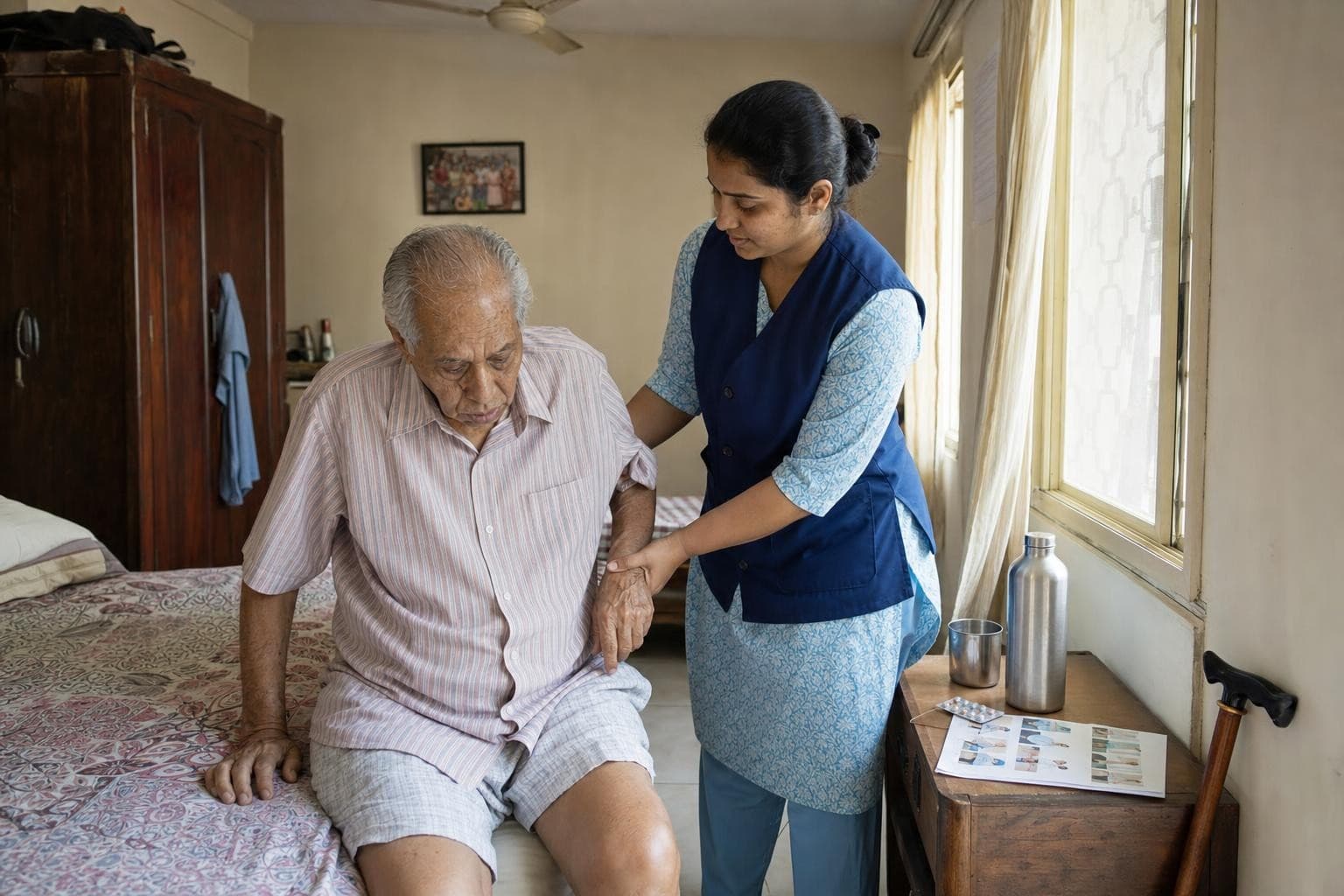
The hospital sends you home with a discharge summary, a physiotherapy sheet, and a list of medicines. It does not send you a plan for Tuesday afternoon, when your father wants to get up and use the bathroom by himself and you have to decide, in three seconds, whether to let him try.
Caring for a parent after a stroke at home is mostly made of decisions like that one. Small, physical, and made without a doctor in the room.
The good news is that most of it has a right answer, and the right answer repeats. Once a family learns the pattern for moving, feeding and exercising safely, the day stops feeling like a series of emergencies.
What actually changed, and why it matters at home
A stroke damages a specific part of the brain, and the effects it leaves behind depend entirely on which part. That is why two stroke patients can look nothing alike a week later. One favours a weak left arm and speaks normally. Another speaks slowly, searching for words, with both arms working fine.
For home care, three things usually matter most. Weakness on one side of the body, which changes how a person needs to be moved. Swallowing difficulty, which changes how they are fed. And changes in speech, memory or judgment, which change how much they can be trusted to make their own calls about what they can safely do alone.
None of these improve on a fixed schedule. Recovery in the first months is real but uneven, with better days and flat weeks that can feel like going backwards. Families who expect a straight line get discouraged fast. The ones who don't tend to hold the routine together longer, which is usually what recovery actually needs.
Positioning and moving a parent without hurting the weak side
The weak arm is the part families injure most often, usually by accident, usually while helping.
A stroke-weakened shoulder has poor muscle control holding the joint in place. Pull on that arm to sit someone up, or let it dangle while moving them in bed, and the joint can partially slip out of its socket. This is common enough that physiotherapists have a name for it: shoulder subluxation. It is painful, and it slows recovery in the arm for weeks.
The safer habit is simple. Never pull the weak arm to lift or turn a patient. Support it under the elbow and shoulder instead, the way you would carry something fragile rather than drag it.
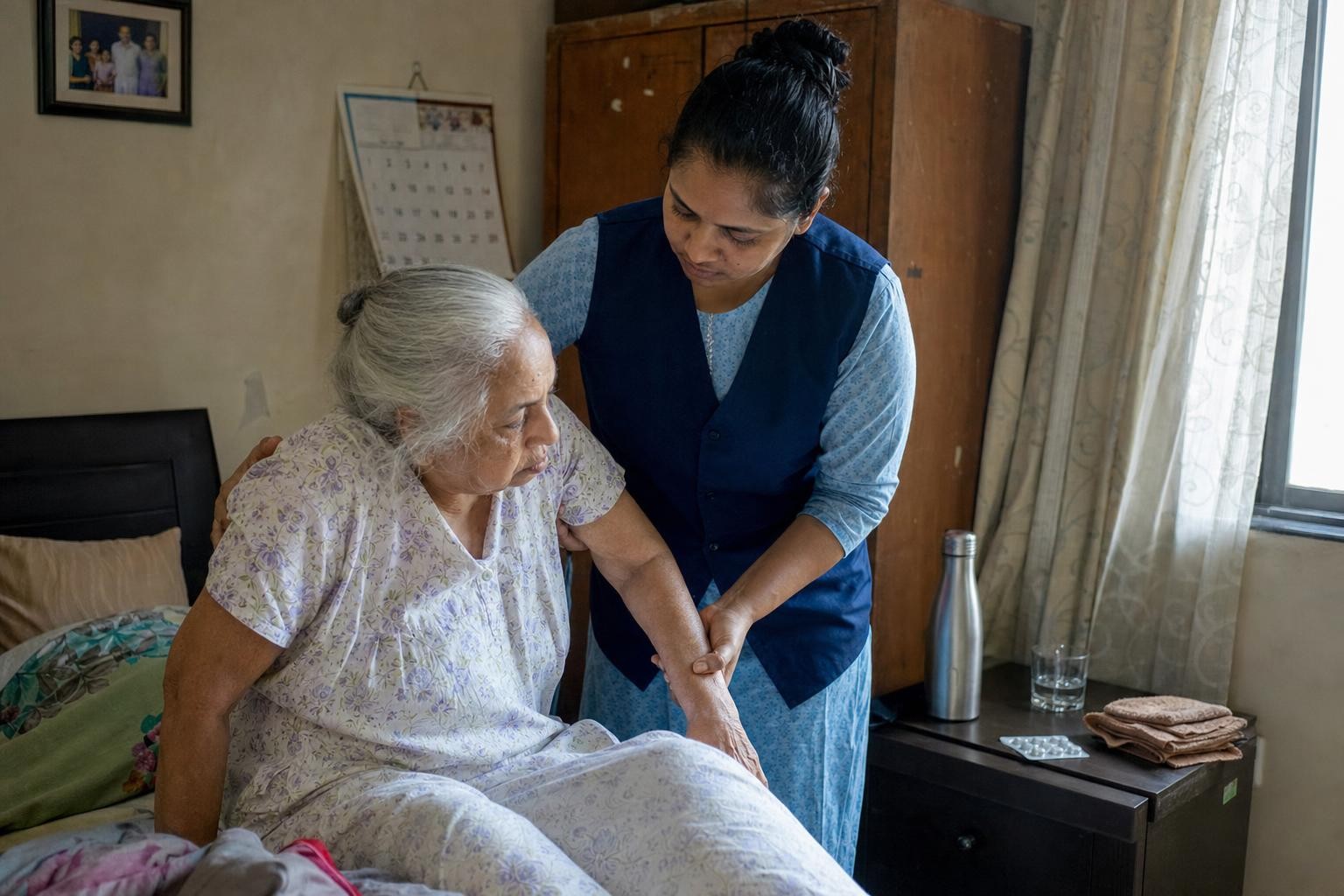
When your parent is sitting, a pillow or armrest should hold the weak arm in a position where it isn't hanging off the edge of a chair. When lying down, a pillow along that side keeps it from rolling into an awkward angle overnight. The same care that prevents pressure sores in any bedbound patient, changing position regularly and checking the skin, matters even more here, since a stroke patient often can't feel or report discomfort on the affected side the way a healthy adult would.
Getting up from a chair or bed should always lead with the stronger side. Stand on the weak side yourself, close enough to catch a stumble, and let your parent push up through the strong leg and arm. Rushing this, or letting pride talk someone into standing alone before they're steady, is how most post-stroke falls happen at home.
Feeding, when swallowing is not what it used to be
Swallowing difficulty after a stroke, called dysphagia, is easy to miss because it doesn't always look dramatic. A slight cough after sips of water. A wet, gurgly voice right after eating. Food pocketing in one cheek without the person noticing. Each looks minor on its own.
Left unaddressed, it isn't. Food or liquid entering the airway instead of the food pipe can cause aspiration pneumonia, a lung infection that is one of the more dangerous complications in the months after a stroke. It's often the reason an otherwise recovering patient ends up back in hospital.
A speech or swallowing assessment, usually done before discharge or soon after, tells you what texture of food is safe. Some patients manage normal meals. Others need food thickened, or liquids given as a gel instead of plain water, at least for a while. Follow that guidance exactly rather than judging by how the meal looks, because the risk isn't visible in the food. It's in how the throat handles it.
Sit your parent fully upright for every meal, never reclined, and keep them upright for a good twenty minutes afterward. Small spoonfuls, unhurried, work better than a full plate pushed through quickly. If swallowing has failed to the point where a doctor recommends tube feeding instead, our piece on Ryle's tube feeding at home covers the routine a nurse teaches a family before handing it over.
The physiotherapy routine that happens between sessions
A physiotherapist's visit, whether it's twice a week or daily, covers maybe an hour. Recovery happens in the other hours, in the exercises a family keeps up on their own.
Most therapists leave a written sheet: specific movements, a number of repetitions, a frequency. The single biggest reason progress stalls isn't a bad exercise plan. It's a good one that nobody follows once the therapist leaves the room.
Recovery in the weeks after a stroke happens in the exercises done when no one is watching, not in the hour the physiotherapist is there.
Keep a simple log, even a page in a notebook, of what was done and when. It gives the therapist something real to adjust against on the next visit, and it tells a tired family whether they're actually keeping pace or just feeling like they are.
Between sessions, the job is mostly encouragement and safety, not technique. Sit beside your parent while they do the assigned movements. Correct posture gently. Don't take over the exercise for them. Resist the urge to do things they've been asked to attempt alone, even slowly, because that struggle is how the brain rebuilds the pathway.
A trained attendant can also sit through these sessions when a family member can't be there every day, prompting the routine and watching for fatigue or pain that should be reported back to the therapist. That kind of support, alongside vitals checks and general bedside care, is what our bedside care at home service covers, with current visit pricing on the page.
The signs that mean an ambulance, not a callback
A second stroke is a real risk in the months after the first, and it doesn't always look identical to the one before it.
The warning signs are the same ones you'd recognise from the first event, and they deserve the same urgency. Sudden weakness or numbness on one side of the face, arm or leg, especially if it's new or worse than the recovering baseline. Sudden confusion or trouble speaking. Sudden vision problems in one or both eyes. Sudden severe headache with no clear cause. Sudden trouble walking, dizziness or loss of balance.
The word doing all the work there is sudden. A gradual change over days is worth a call to the treating doctor. A sudden change, even a brief one that seems to pass, is not something to wait out. It needs an ambulance and a stroke-capable hospital immediately, because the treatment window for a second stroke is measured in hours, not days.
Don't wait to see if it improves. Don't call the family doctor first and lose twenty minutes. Every stroke unit will tell you the same thing: time lost is brain lost.
Questions families ask
How soon after a stroke can physiotherapy start at home?
Often within days of discharge, once the treating doctor and physiotherapist confirm the patient is medically stable. Early, gentle movement generally helps recovery instead of risking it, but the pace and type of exercise should come from the therapist, not guesswork.
Is it normal for recovery to plateau or even seem to regress?
Yes, and it's one of the most discouraging parts for families. Recovery after a stroke is rarely a straight line. A flat week or a bad day doesn't mean progress has stopped, though a real, sustained decline should always be mentioned to the doctor.
Can a stroke patient be left alone at home during the day?
It depends entirely on what changed. Weakness alone, with clear speech and judgment, may allow supervised independence for short periods. Confusion, impulsivity or a fall risk usually means someone needs to be present, at least until the treating team says otherwise.
What is the biggest mistake families make with the weak arm?
Pulling or lifting through it to help someone move. It feels like the natural handhold, but it's how a shoulder gets partially dislocated. Support under the elbow and shoulder instead.
Does every stroke patient need a caregiver or attendant at home?
No. Some families manage entirely on their own, especially with mild weakness and good cognition. Others need help with transfers, feeding or supervision, at least in the first weeks. It's worth reassessing the need every few weeks instead of deciding once and never revisiting it.
How do I tell a small setback from a second stroke?
Speed is the clue. A slow change over days needs a doctor's opinion soon. A sudden new weakness, slurred speech, vision loss or severe headache needs an ambulance immediately, not a wait-and-see approach.
Healkin facilitates care at home and does not diagnose, prescribe, or change a doctor's treatment plan. If you notice sudden weakness, confusion, slurred speech, vision changes or a severe headache, call an ambulance immediately rather than waiting for a scheduled visit.