ECG at Home in Mumbai: What the Tracing Can Tell a Doctor, and What It Cannot
A resting ECG at home in Mumbai answers a narrow question well and a wide one not at all. Here is what a twelve-lead tracing actually captures, and the chest-pain situation where the right move is an ambulance, not a booking.
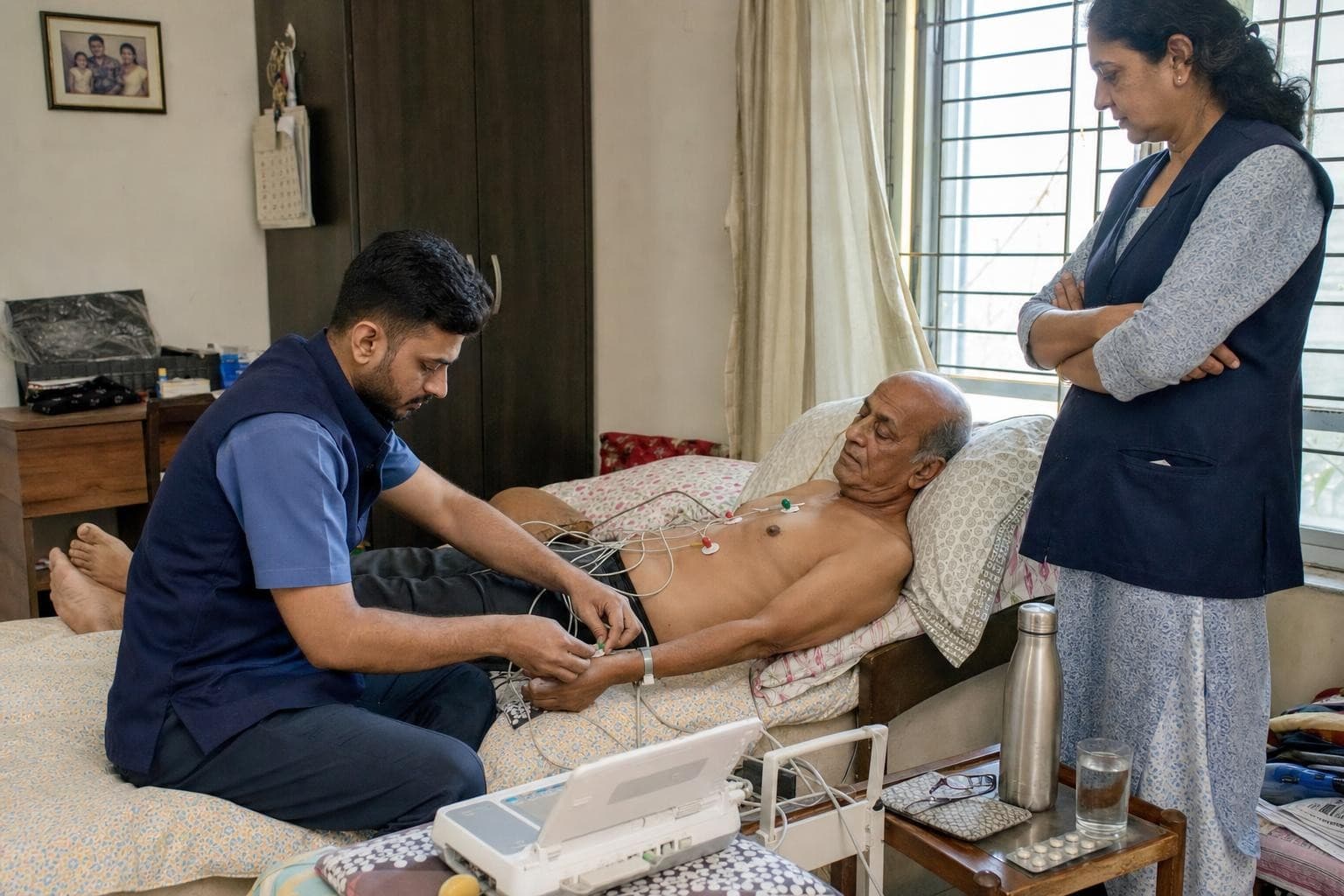
Somebody's father says his chest has felt tight climbing the stairs for a week. Nothing dramatic, nothing that sent anyone to a hospital. Just enough to make his daughter want it looked at before it becomes something that does. That's the situation a home ECG is built for, and it's worth being precise about what the tracing will and won't settle that afternoon.
A resting ECG at home in Mumbai is a fifteen-minute visit. A technician arrives with a portable twelve-lead machine, sticks ten small electrodes to the chest, arms and legs, and records a few minutes of the heart's own electrical activity while the patient lies still. Nothing is injected. Nothing enters the body. The machine listens, it doesn't stimulate anything. That part surprises people who've never had one done, and it's usually the first thing worth saying out loud to whoever's nervous about it.
What twelve leads actually see
Every heartbeat starts as an electrical signal, and that signal travels through the heart in a specific pattern before the muscle contracts. A twelve-lead ECG places electrodes at ten points on the body and combines their readings into twelve different views of that same signal, each one looking at the heart from a slightly different angle.
That's what makes it useful for more than "is something obviously wrong." A doctor reading the tracing can see the heart's rate and rhythm, whether the electrical signal is taking longer than it should to travel between chambers, and patterns that suggest a section of heart muscle isn't getting the blood supply it needs. Old heart attacks sometimes leave a signature on the tracing years later, which is part of why a cardiologist asks for a fresh ECG even from someone who feels fine.
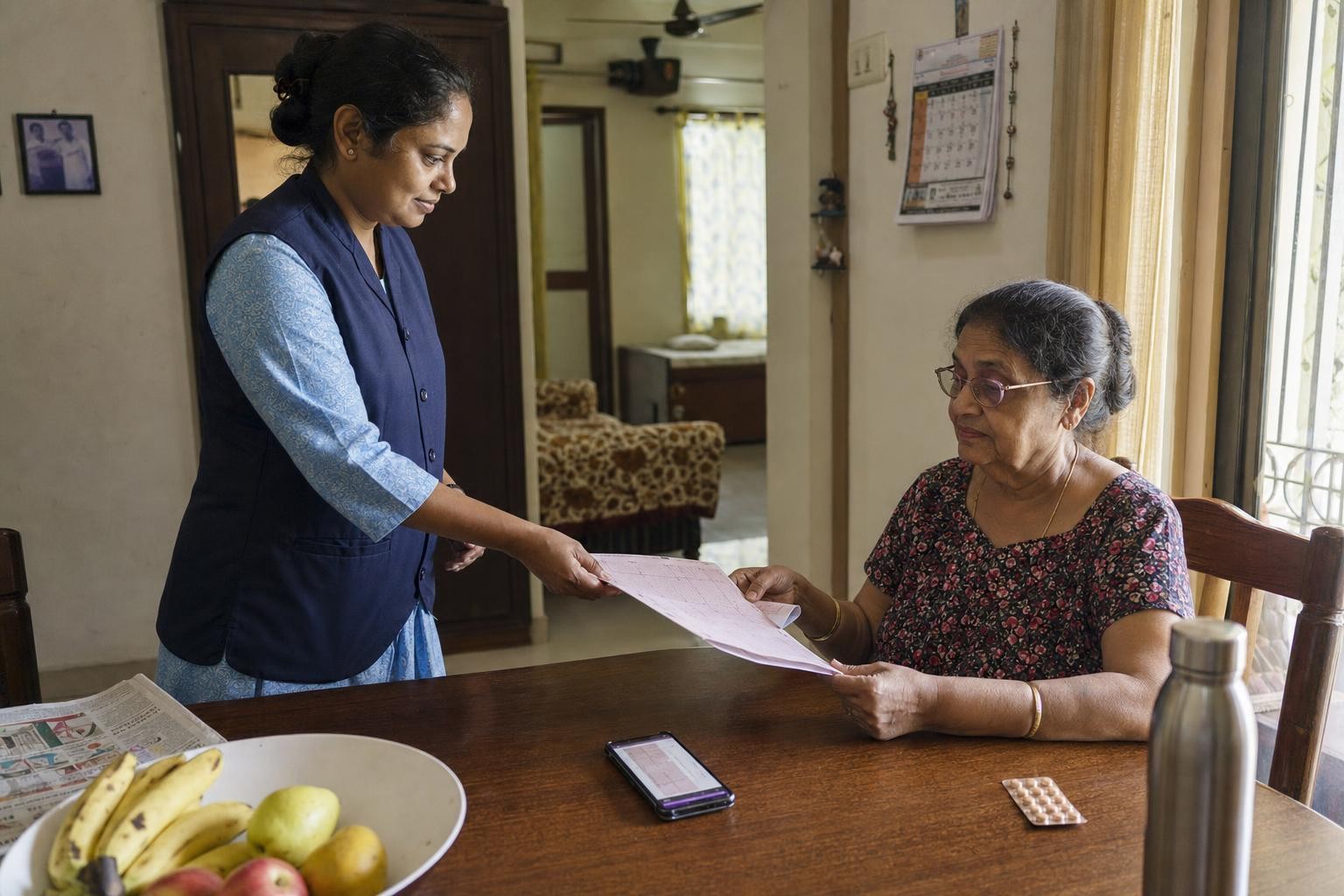
None of that reading happens at the bedside. The technician's job is the recording, not the diagnosis. We deliver the report; a doctor who knows the patient's history reads it. If there isn't one already in the picture, that's usually the next call to make, not a second ECG.
The tracing is a snapshot, and snapshots miss things
Here's the part that trips families up. An ECG records what the heart is doing during those few minutes, nothing before and nothing after.
A rhythm problem that comes and goes, an irregular beat that shows up twice a week for thirty seconds, can sit inside a completely normal tracing if the technician happens to catch a calm patch. That's not the test failing. It's the test doing exactly what it's designed to do, which is look at right now. If the palpitations are intermittent, tell the doctor that when you hand over the report. It usually means the next step is a longer recording, not a repeat of the same fifteen minutes.
The same limit applies to chest pain that comes and goes with exertion. A resting ECG taken while someone is sitting calmly can look normal even when there's a real problem that only shows up under load. That's a different test entirely, and it's the doctor's call to make after seeing this one, not something a home visit substitutes for.
Who actually books this
Most home ECGs aren't emergencies. They're routine, and that's the point.
A cardiologist wants a fresh tracing before adjusting a heart medication. A surgeon or an insurer asks for one before signing off on a procedure. A family managing long-standing diabetes or high blood pressure gets one done alongside the usual checkup, because heart strain from either condition often shows up on an ECG before it shows up as a symptom anyone would notice. And plenty of people over forty book one simply as a baseline, so a doctor has something to compare against later if anything changes.
For a bedridden patient, an elderly parent who dreads the trip to a clinic, or someone recovering from surgery who shouldn't be sitting in a waiting room, the appeal is obvious: the machine comes to the bedroom instead. Nobody who shouldn't be moved gets moved.
What chest pain right now means
This is the one distinction worth repeating until it's boring. If someone is having chest pain right now, especially with breathlessness, sweating, fainting or a crushing tightness across the chest, that is not a moment to book a home visit and wait for a callback. Call an ambulance or get to the nearest emergency room immediately.
A scheduled ECG is for a heart you want checked. An ambulance is for a heart that's in trouble right now.
A home ECG is a diagnostic snapshot taken on a calm day, not a substitute for emergency cardiac care, and it should never be used to wait out symptoms that need a hospital's monitoring and equipment. The technician who comes to record a routine tracing isn't equipped to manage a cardiac emergency, and the fifteen minutes it takes to arrive is fifteen minutes better spent getting to a hospital.
Preparing for the visit
There's not much to do beforehand, which is most of the appeal. Wear something that gives easy access to the chest, wrists and ankles rather than layers that need removing at the door. Skip the body oil or lotion that morning, since it can loosen the electrode's contact with the skin and blur the tracing. If there's an old ECG report in the house, or a prescription noting why the doctor wants one, keep it within reach. It gives the doctor reading the new one something to compare against, and it tells the technician what the visit is really about.
Families who are already coordinating other things after a diagnosis or a discharge often find an ECG is one piece of a longer list. The fuller picture of what home healthcare in Mumbai covers is worth a read if diagnostics are only one part of what's been arranged, so a booking doesn't get missed or duplicated.
Some households are running this alongside a fasting blood panel, timed for the same morning to save a second visit. If that's the case, what actually makes a fasting blood test at home go smoothly is worth reading first, since the fasting rules and the ECG prep don't conflict but the timing does need planning.
Questions families ask
Do I need a prescription to book a home ECG?
No. An ECG only records the heart's own electrical activity, so it's non-invasive enough to book without a doctor's note. Bring a prescription or referral to the visit if you have one, since it tells us what the doctor is looking for, but it isn't a requirement.
Is an ECG at home as accurate as one done in a hospital?
The machine and the electrode placement are the same, and the recording is read by a doctor either way. What changes is where it happens, not how it's read. What a home ECG can't do is run a treadmill stress test or continuous monitoring over hours or days, which need equipment that doesn't travel.
Can I book this for a parent who can't sit up on their own?
Yes, and a large share of home ECGs are exactly that. The technician positions the electrodes with the patient lying down, so there's no need for anyone to sit, stand or be moved to a clinic chair.
What if the report shows something abnormal?
The report goes to you, and you take it to the treating doctor or cardiologist for what it means. We don't diagnose over the tracing. If there's no doctor already involved, our Care Team can point you toward a doctor-at-home visit to go through the report together.
How is this different from a cardiac stress test?
A resting ECG records the heart at rest, over a few minutes, at home. A stress test (TMT) records it while the heart is under exertion, usually on a treadmill, in a facility built for it. A doctor decides which one is needed based on the symptoms, and sometimes a resting ECG is what leads to that referral.
Can I get this done for a pre-employment or visa medical?
Yes, this is one of the more common reasons families book it. Tell the Care Team it's for a fitness or clearance certificate when you call, since the paperwork format sometimes differs from a routine diagnostic report.
Healkin facilitates care at home and does not diagnose, prescribe, or change a doctor's treatment plan. Chest pain, severe breathlessness, fainting or sweating with chest tightness are reasons to call an ambulance or go to the nearest emergency room immediately, not to book a scheduled ECG.