
Urinary Catheter Care at Home: The Daily Routine and the Signs That Mean Call Today
A catheter and drainage bag need a routine, not guesswork. Here is the daily hygiene that keeps infection away, how often a Foley is actually changed, and the four signs that mean call today.
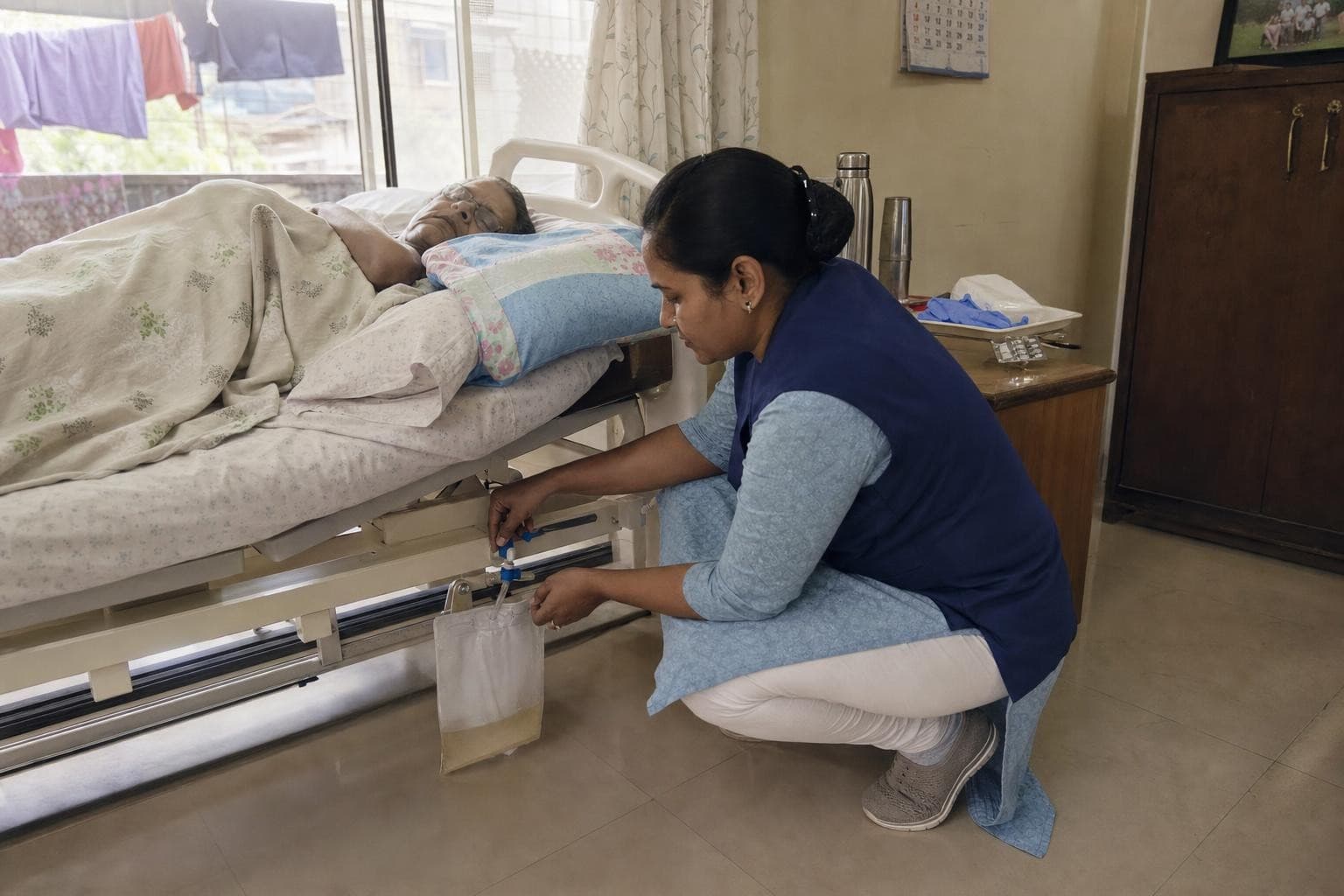
Nobody hands you a manual when a relative comes home with a catheter still in. The discharge nurse says "keep the bag below the bladder, empty it every few hours" in the last five minutes before you leave the ward. Then you're standing in your own hallway with a bag of urine strapped to a bed rail and a list of questions nobody had time for.
Urinary catheter care at home in Mumbai exists because a catheter isn't a one-time procedure. It's a routine, running for as long as the doctor keeps it in. Most of the problems that send a family back to hospital start with one small step in that routine skipped, not with anything dramatic.
The daily bag-and-hygiene routine
One rule matters more than all the others. The bag stays below the level of the bladder. Always. Lying in bed, sitting in a chair, being moved between the two.
Lift a bag above the bladder, even for a moment while shifting someone from bed to wheelchair, and urine flows backward along the tube. That backward flow is one of the commonest ways bacteria travel up into the bladder. If the bag has to come off the bed frame to move the patient, hold it low. Never rest it on the mattress or prop it on a lap.
Empty when it's roughly half to two-thirds full. Not once a day on a fixed schedule. A bag left to fill completely puts weight on the tube where it enters the body and drags at skin that's already strained. Wash your hands before touching the drainage valve. Open the valve over a clean jug, not straight into a toilet where splashback is hard to avoid. Wash again after. And check the tube for kinks each time, because a bent tube stops drainage just as well as a blocked one. It's also the easier problem to fix.
The area where the catheter enters the body needs washing once a day. Plain soap and water, nothing more elaborate, wiping away from the entry point rather than toward it. Antiseptic creams and powders aren't routinely needed and can irritate skin that mild soap would have left alone. The direction of the wipe matters more than the product. Once a day, gently, and straight away if there's visible soiling.

How often a Foley catheter is actually changed
A Foley isn't left in indefinitely. Silicone catheters are typically changed every four to six weeks, latex ones sooner. The doctor sets the exact interval based on how the patient's body responds, because some people develop encrustation or irritation faster and need a shorter cycle.
The change itself is quick. Old catheter out, area checked, new one in using sterile technique. A trained nurse does it at home. No hospital visit needed.
What confuses families is the difference between changing the catheter and changing the bag. The bag, or at least the connecting tube, is generally replaced more often than the catheter, sometimes weekly, because tubing degrades and the connection point is where leaks start. The catheter follows the doctor's schedule. The bag follows its own. A nurse visiting for catheter care checks both, instead of assuming one implies the other is fine.
A blocked catheter rarely announces itself with pain first. It shows up as a bag that has stopped filling.
The four warning signs that mean call today
Fever. It doesn't have to be high. A temperature you'd shrug off in most situations is worth a same-day call when someone has a catheter in, because a urinary infection can reach the kidneys or the bloodstream faster than an infection almost anywhere else.
Urine that has turned cloudy, strongly foul-smelling, or visibly bloody. A faint pink tinge that clears within a day is one thing. Bright red blood or clots in the tubing is another, and it needs looking at today, not at the next scheduled visit.
A bag that has stopped filling, or is filling far less than usual, especially with lower abdominal discomfort alongside it. That usually means a blockage: a kink, sediment, or a clot. An empty bag is not good news here. It means urine has nowhere to go, not that none is being made.
Leaking around the catheter, with urine escaping alongside the tube instead of through it. A little during a cough or a sudden movement isn't automatically alarming. Constant or increasing leaking usually means the balloon holding the catheter has shifted, or the size no longer suits the patient. That needs a nurse, not more absorbent pads.
Living around a catheter day to day
Bathing is generally fine with a catheter in. A quick shower is easier to manage than a full bath, and the bag can stay low and dry instead of coming off. Disconnecting the closed system more often than you need to is one of the easier ways to introduce infection.
Sleep is easier with a larger overnight bag on the bed frame than with the smaller leg bag some patients wear in the day. Switch back each morning.
Moving around the house is manageable too, to a balcony, to the dining table for meals, as long as whoever moves the patient thinks about bag height first. A bedbound patient who needs catheter care often needs the same two-hourly turning routine that prevents a bedsore running alongside, because reduced mobility and a catheter tend to arrive together. And when a catheter comes home as part of a wider discharge, alongside a fresh IV line or a wound still needing dressing, our piece on what a home IV drip actually looks like walks through that routine too.
Questions families ask
Can a family member empty and change the drainage bag themselves?
Emptying it, yes. Most families manage confidently after being shown once, since it's mainly hygiene and the height rule. Changing the bag, and certainly changing the catheter, is better left to a nurse using sterile technique. The entry point is exactly where an untrained attempt introduces infection.
Is a small amount of blood in the bag always an emergency?
No. A faint pink tinge, especially right after an insertion or a change, is common and usually settles on its own within a day. Bright red blood, blood getting heavier instead of lighter, or visible clots in the tubing is different, and needs a same-day call.
Why does the urine smell strong even without other symptoms?
Usually hydration. Concentrated urine, from not drinking enough through the day, smells stronger without anything being wrong. What matters is whether the smell arrives with cloudiness, fever or discomfort. On its own it's rarely an infection.
Does Healkin's home visit cover both catheter changes and bag care?
Yes. A home visit can cover routine catheter changes, urinary catheter insertion and removal, and general tube care. Suitability and any patient-specific requirements are confirmed when you book. Insertion needs a prescription.
Can the patient still go out with a catheter in place?
Short outings are usually fine once the family is confident with the bag and tubing. A leg bag under loose clothing is far less noticeable than the overnight one. For longer outings or travel, check with the doctor first, particularly if a change is due soon.
What if the tube looks kinked but the patient has no other symptoms?
Straighten it gently and see whether drainage resumes within a few minutes. If it does, you're done. If the bag still isn't filling once the kink is cleared, treat it as a possible blockage and book a same-day visit. Don't wait to see if it resolves overnight.
Healkin facilitates care at home and does not diagnose, prescribe, or change a doctor's treatment plan. Fever, cloudy or bloody urine, a bag that has stopped filling, or leaking around the catheter are reasons to call your doctor the same day rather than waiting for a scheduled visit.