
Replacement caregiver during festivals in Mumbai: how to cover a fortnight without starting over
Nurses and attendants go home in Ganpati and Diwali week, and every household on your street loses its help at once. Here is why the gap opens, what to write down before it does, and how to keep a stranger from starting from zero.
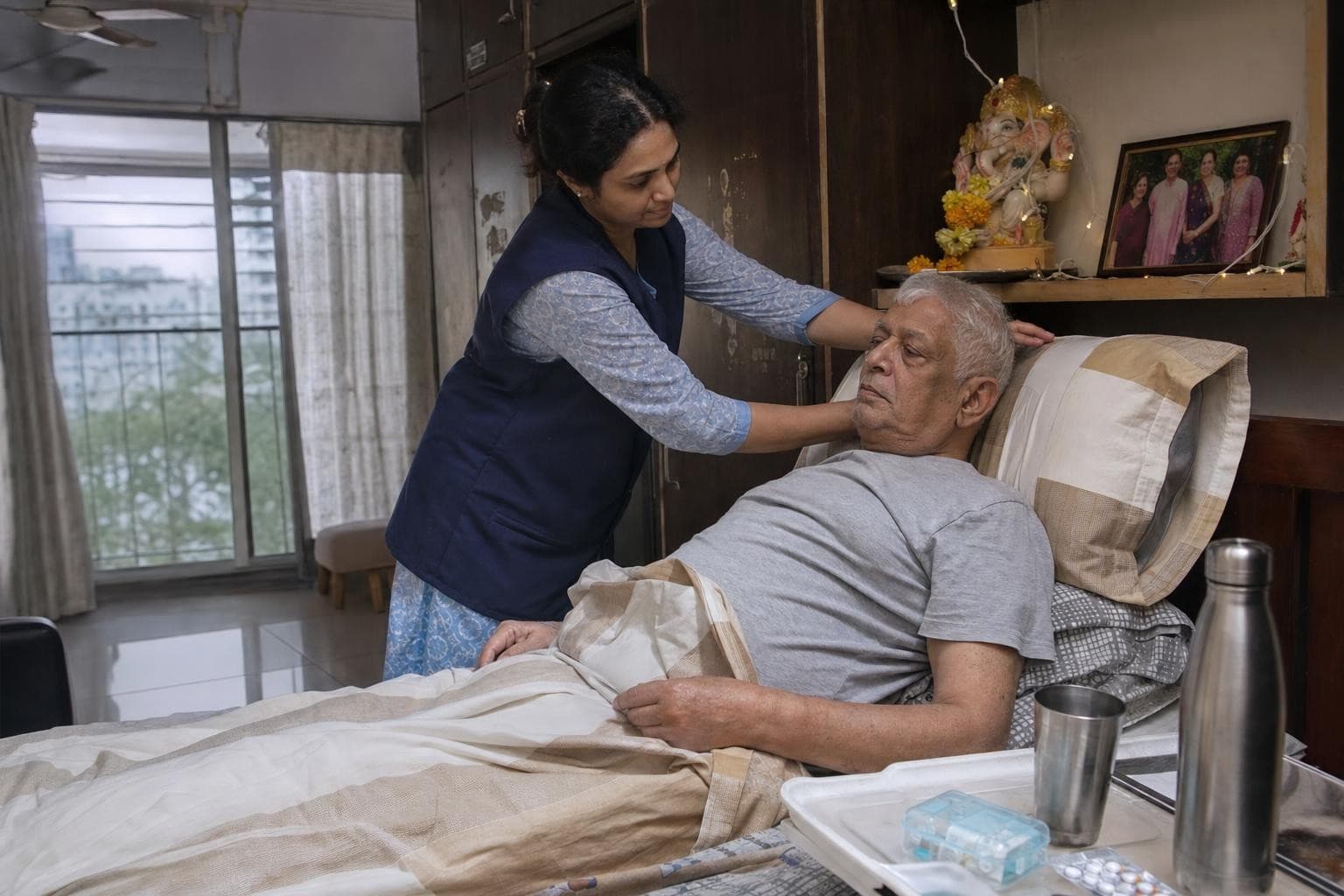
The call usually comes three days before Ganesh Chaturthi. Your father's nurse, the one who has been coming for eight months, says they're leaving for the village on Friday. Back on the 25th, they think. Maybe later.
You need a replacement caregiver during the festival, and so does everyone else on your street. That's the whole problem in one sentence.
This post is about why the gap opens, what breaks when it does, and how to cover a week or a fortnight without your parent meeting a stranger who has to learn everything from scratch. It applies to Ganpati, and just as much to Diwali and the long summer weeks when half the city goes home.
Why help vanishes all at once
Many of the nurses and attendants working in Mumbai's flats come from other states and districts. The festival is when they go home to their own families, and after a year of other people's routines, they've earned it.
Nobody is being unreasonable. But the timing is the same for everyone. Every household that depends on one person loses that person in the same week, and every one of them starts phoning around on the same afternoon.
That's why it feels like help disappears overnight. It hasn't gone anywhere. It has been booked, mostly by people who asked earlier than you did.
An agency's roster works the same way. The earliest requests get the widest choice, and the last ones get whoever is free. A fortnight's notice gets you a conversation about who suits your parent. Two days' notice gets you a name.
What breaks when the regular person leaves
The obvious answer is that the work stops. It rarely does. Somebody turns up.
What goes missing is everything the regular caregiver never wrote down, because they never had to. They know your mother won't eat until the radio is on. They know which side she turns to when the pain is worse, that the left arm is the one to avoid for the BP cuff, that the evening tablets go with curd and not with water.
None of that is on the discharge summary. It lives in one person's head, and it leaves for the village on Friday.
A new caregiver arriving without it isn't careless. They're blind. They'll do the visible tasks well and miss the invisible ones, and a patient who can't explain herself, which describes many of the people we're talking about, has no way of filling the gap.
The routine is what you're really hiring cover for. The tasks are the easy part.
Write the routine down before they go
You have a few days, or a week if you're organised. Use them on this, because it's the cheapest thing you can do and it matters more than anything else on this page.
Sit with the regular caregiver for twenty minutes and ask them to talk you through an ordinary day. Write it as they say it. Don't tidy it up.
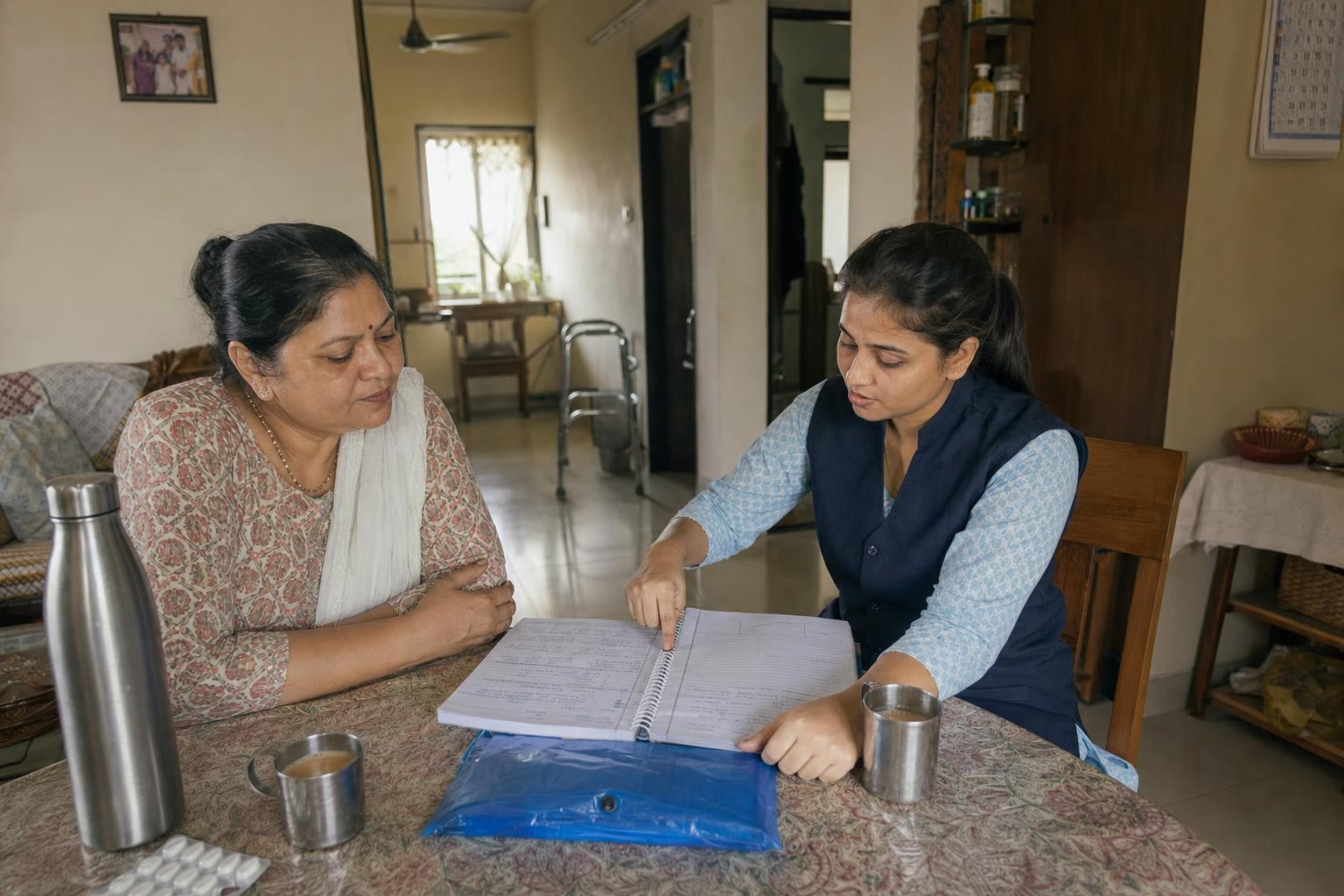
A useful handover covers these:
Wake-up and sleep. The actual times, and what happens either side of them.
Meals. What's eaten, how it's served, what gets refused, and how much help the feeding needs.
Medicines. The schedule exactly as the doctor wrote it, and what each one is taken with. Your caregiver doesn't decide any of this. They only need to follow it.
Movement. How your parent gets from bed to chair, which arm to hold, how much they can do alone.
Skin and positioning. How often they're turned, and which patches of skin to look at each day. If your parent is bedbound, our bedsore guide explains the two-hourly routine.
The small things. Radio, blanket, the word they use for the toilet, the thing that calms them at night.
Who to phone. The doctor, the nearest hospital, and you.
Then read it back to the caregiver and let them correct you. They'll fix three things you got wrong.
Keep the sheet somewhere obvious. A folder on the dining table beats a message on a phone that nobody checks. Anyone who walks in should be able to pick it up and be useful within the hour.
Book early, and ask for the same person throughout
If you know your regular caregiver will be away, the best time to arrange cover was a fortnight ago. The second best time is today.
When you book replacement cover for the festival, tell the Care Team the dates you're uncovered, what your parent needs on an ordinary day, and one more thing that families often forget to say: that you want one person across the whole block.
This matters more than it sounds. A fresh face every morning means a fresh handover every morning, and each handover loses a little. An elderly patient who is introducing himself to a new person daily will get through it, but he'll be more anxious and eat less, and small changes will go unnoticed because nobody has been there long enough to spot them.
One person for ten days learns the routine by day three. By day five, they're noticing things.
It also helps to meet the replacement before the regular caregiver leaves, even for an hour. Overlap is the best handover there is. Your usual nurse can show the new one where the spare sheets are and how your mother likes to be lifted, and your mother gets to see the two of them get along.
Attendant or nurse: choose by what a normal day involves
Cover is often booked at the wrong level. Families ask for a nurse because it feels safer, or for an attendant because it costs less, and neither guess is reliable.
The test is simple. Look at an ordinary day and ask whether anything in it is clinical. Turning, lifting, bathing, feeding, toileting and keeping company are attendant work. Dressings, tube feeds, catheter care, injections and IV lines need a qualified nurse.
If your father has none of the clinical tasks, a nurse is money spent on skills he won't use. If he has even one, an attendant isn't allowed to do it, and you'll have a gap at exactly the time of day it matters. Our post on the difference between a home attendant and a nurse goes through where the line falls.
If you're unsure, describe the day to the Care Team and let them tell you. It's a five-minute call.
Twelve hours or twenty-four
A 12-hour shift covers the day or the night. Twenty-four-hour cover means your parent is never alone, overnight included.
Which one you need depends on the nights, not the days. Someone who sleeps through until morning is a different booking from someone who needs turning every two hours, or who wanders, or who is at risk of a fall on the way to the bathroom.
If the regular caregiver normally stays over, don't assume a day shift will do. Ask what they did at 3 a.m., because that's the shift you're replacing.
Roads, processions and the last two days
Festival week in Mumbai is a logistics problem before it's a care problem. Roads close, lanes are diverted, and the last two days of Ganpati are the hardest to move through.
A good replacement plan has a plan for this. Shifts may need to start earlier, so the person on nights isn't stuck at a barricade when the person on days needs to leave. If you live near a route, mention it when you book, so the roster can be built around it.
And keep a family member's number on the sheet for the day a road closes without warning. Roads here have a habit of closing without notice.
When to call the doctor, whoever is in the room
A new caregiver, however good, doesn't know what "normal" looks like for your parent yet. That makes your own instructions the safety net.
Write down what should prompt a call, and give it to whoever is on shift. Use the doctor's own words where you can. As a general rule:
Call your doctor the same day if there's a new fever, a change in how alert your parent is, food or fluids being refused for a whole day, or a fresh red or broken patch of skin.
Call an ambulance, not a callback, for chest pain, sudden difficulty breathing, a sudden weakness on one side of the body, or a fall with a head injury.
A festival week is a poor time to wait and see. Some clinics keep short hours and the traffic is unpredictable. If you're wondering whether to call, call.
Questions families ask
How far ahead should I arrange a replacement caregiver for Ganpati?
Two weeks before Ganesh Chaturthi is comfortable. The whole city wants the same days, so the roster fills from the earliest bookings. A late request can still be taken, but you'll have less choice about who comes.
Can I get the same replacement for all ten days?
Usually, yes, and it's worth asking for when you book. Continuity matters more for an elderly patient than almost anything else. Say so when you book and the Care Team will try to hold one person across the block.
What if the replacement doesn't turn up?
Call the office straight away and they'll send someone else the same day. Having a number to ring is most of what you're paying for, compared with a neighbour's contact that goes to voicemail on the day of a procession.
Do I need cover for Diwali and Christmas too?
If your regular caregiver goes home for them, yes. The same problem shows up wherever a lot of people travel at once, including the summer village season. Call when you know the dates, not when the day arrives.
Can the replacement do household work as well?
No. Cooking, cleaning and laundry aren't part of patient care, and mixing the two is how care slips. Keep household help separate so the caregiver's time stays on your parent.
What should I do if my parent gets upset about a new face?
Introduce them before the regular caregiver leaves, and keep the routine identical for the first few days. Familiar sounds and objects help. If the distress goes on or gets worse, speak to your doctor, because a sudden change in mood can have a medical cause.
Healkin facilitates care at home. We don't diagnose, prescribe or change a doctor's treatment plan, and nothing here replaces your own doctor's advice. If you're worried about a symptom, call your doctor.